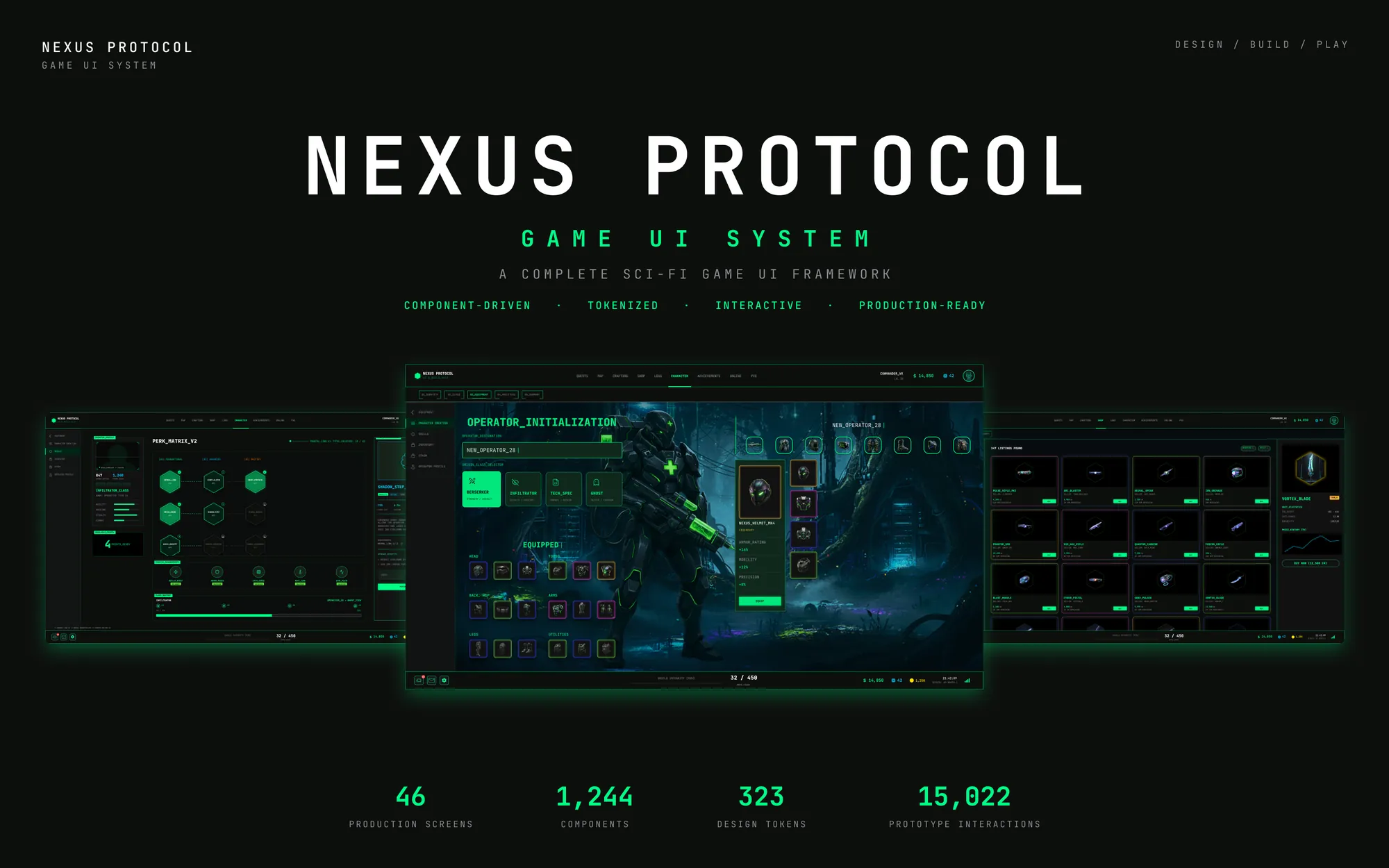
46
Screens
Boot to endgame — menus, HUD, social, economy.
1,244
Components
172 component sets with every state as a variant.
323
Design Tokens
9 variable collections. Restyle the kit in minutes.
15,022
Interactions
A prototype you can actually play through.
2560
× 1440 · PC
Scales cleanly to 4K and Full HD.
Nexus Protocol — Sci-Fi Game UI System cover

Not screens.
A system.

Nexus Protocol is a complete sci-fi game interface for desktop — boot, login, main menu, in-world HUD, character, inventory, world map, missions, social hub and in-game economy. Every screen is assembled from the same tokenized component library, so the whole kit restyles from one place and new screens are built from parts that already exist.
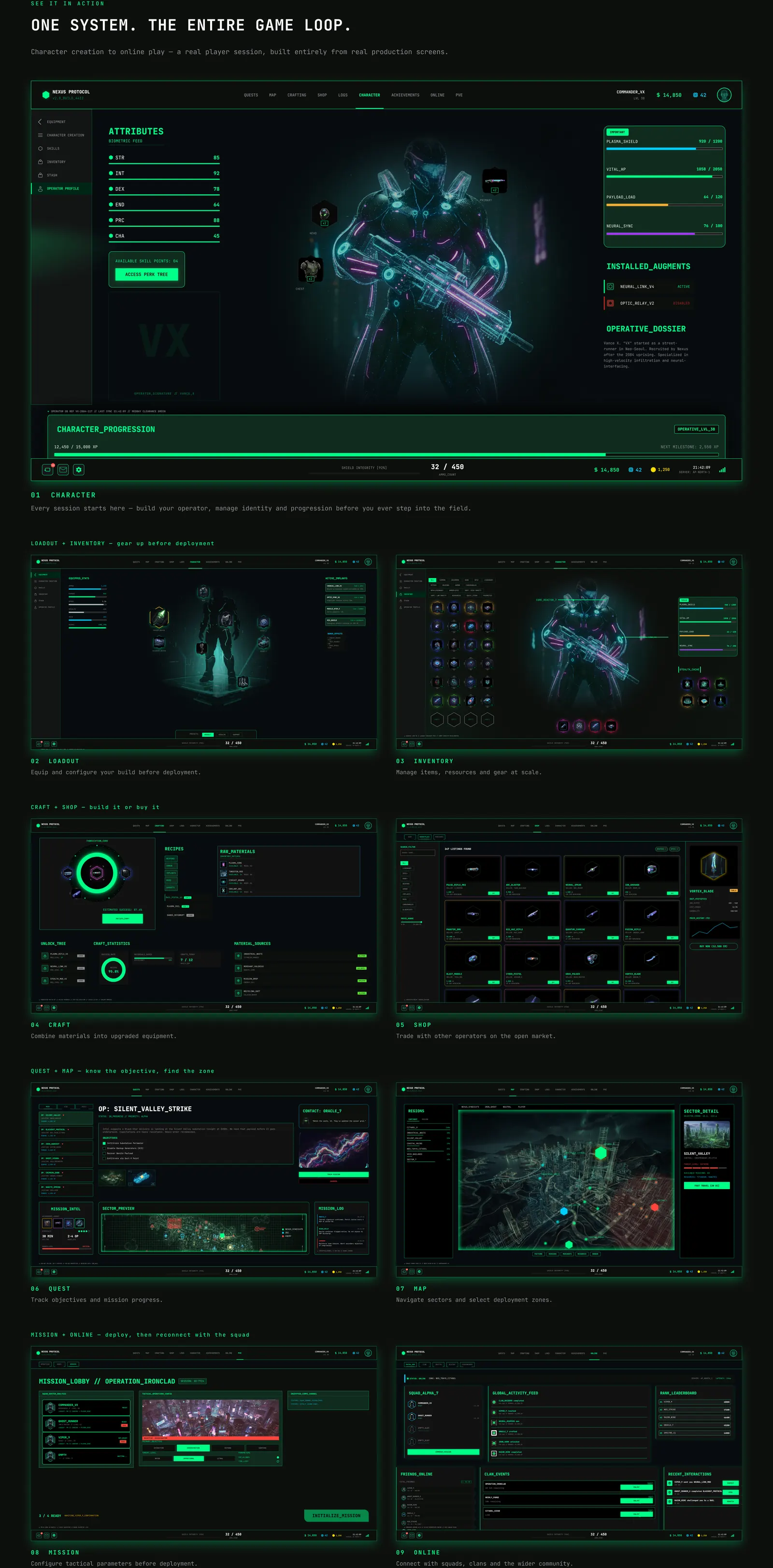
Nexus Protocol — one system, the entire game loop
One system, the entire game loop — character, loadout, inventory, crafting, shop, quests, map, mission lobby and social, all from real production screens.
01 — Component First

Screens never own reusable UI.

Every repeated pattern belongs to exactly one component. Screens only assemble them — so a fix in one place reaches every screen.

02 — Tokenized

No raw hex. Ever.

Color, spacing, radius, opacity, effects, typography and stroke weight all run on 323 variables in 9 collections.

03 — Function over Decoration

Every glow carries information.

Military, terminal, tactical. Borders, colors and glows mark state, rarity or danger — never decoration for its own sake.

04 — Navigation System

Six levels. One answer per level.

Global top bar, section tabs, filters, detail panel, workflow steps, modals. The player always knows where they are.

05 — Prototyped

A loop you can play, not a slideshow.

Boot → menu → lobby → mission → HUD → pause → back. Including a downed and respawn loop. No dead links, no dead ends.

06 — Named for Handoff

Structured like a real UI codebase.

Nexus / Category / Name. Readable variant properties, a fixed screen hierarchy, zero broken instances.

↑ Click any tab above to dive into that part of the system
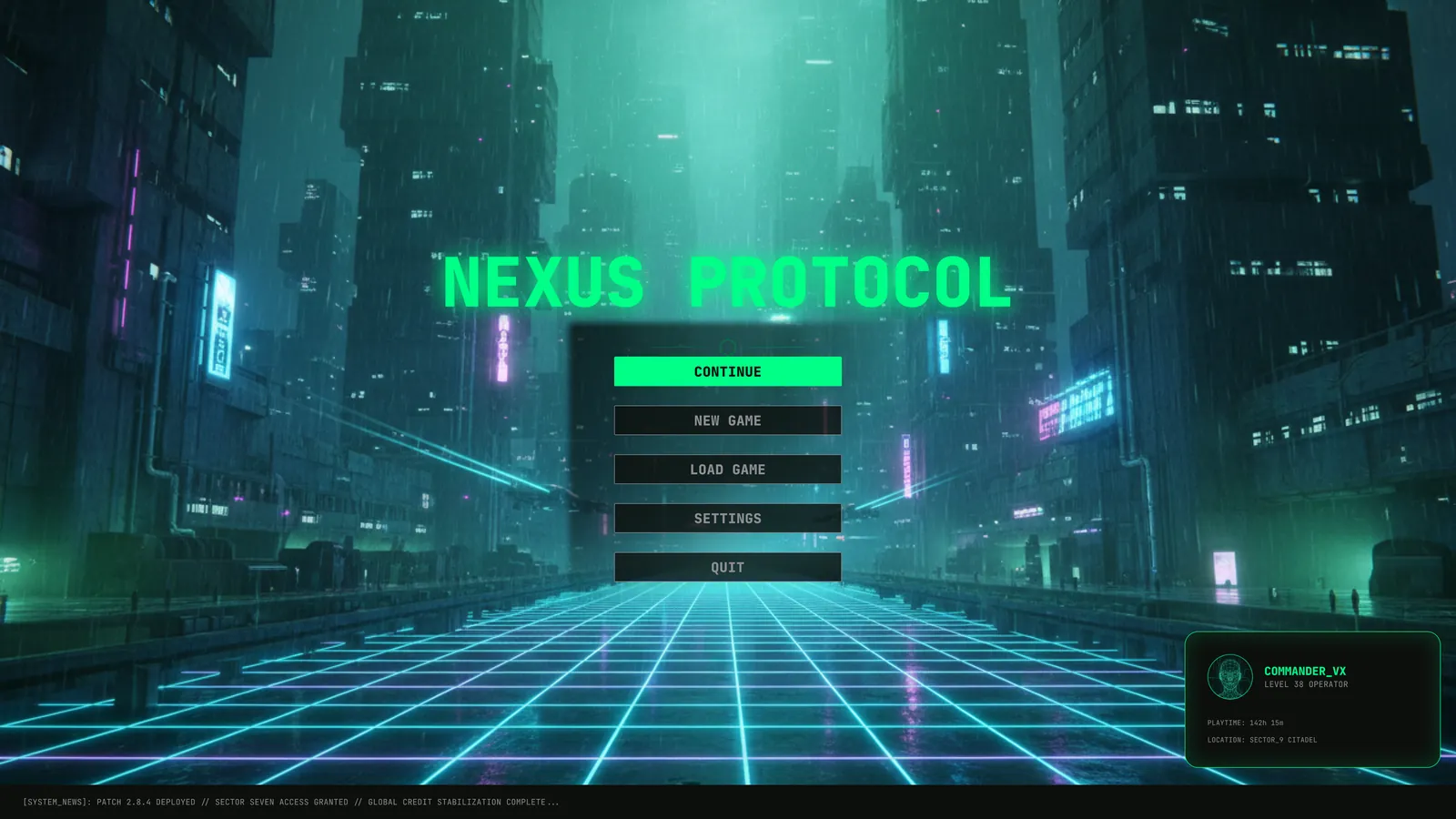
Main menu screen
Boot & Menus →
In-world combat HUD
In-World HUD →
Inventory screen
Character & Inventory →
World map screen
World Map →
Quest screen
Missions & PvE →
Social hub screen
Social & Clan →
Shop screen
Shop & Economy →
Component system
Component System →

46 complete PC game screens.
Boot, Login & Main Menu HUD — 3 states + Pause Character & Inventory Skill Tree & Loadout World Map — 7 regions Quests, PvE & Lobby Social, Clan & Leaderboards Shop, Market & Crafting Season Pass & Achievements Intel, Comms & Settings

1,244 reusable components in 172 component sets. Every component follows one naming structure, uses Auto Layout, and is bound to the variable system.

Production-Ready Figma System.
  • Auto Layout throughout
  • 323 variables in 9 collections
  • 1,244 components · 172 component sets
  • 18 text styles · 7 effect styles
  • 7 rarity tiers — Common to Mythic
  • Clickable prototype — 15,022 interactions
  • All screens at 2560×1440 (16:9)
  • No plugins, no external libraries

📖 00 · Nexus — Cover, product presentation, license summary

🎨 Foundations — Colors, typography, tokens, prototype guide

🧩 Components — 172 component sets, organized by category

🖥 Screens — 46 screens, wired as a clickable prototype

🗂 PNG previews — Every screen in Full HD (ZIP), plus LICENSE.txt and README.txt

Font (free via Google Fonts): JetBrains Mono — the only font in the file

Artwork: All images and icons are AI-generated sample artwork (Figma AI) — placeholders, not exclusive. Replace them with your own art before you ship.

Screens 01 — 06 + Settings
Boot, Login & Main Menu
The first minute of the game. Boot initializer, splash, login, title screen, loading screen and main menu — plus a full settings screen. Each one built from the same panels, buttons and type as the rest of the kit.
Design Principle The tone is set before the player presses a key.
7
Screens
Boot
Prototype Start
Hub
Main Menu
Tokens
Figma Variables
Nexus Protocol — main menu
Main menu — Continue, New Game, Load Game, Settings, Quit. Continue and Load Game lead into the loading screen in the prototype.
Login & Title

Authentication as one clear step.

Login and title screen work as a single workflow step: one panel, one primary action, nothing competing for attention.
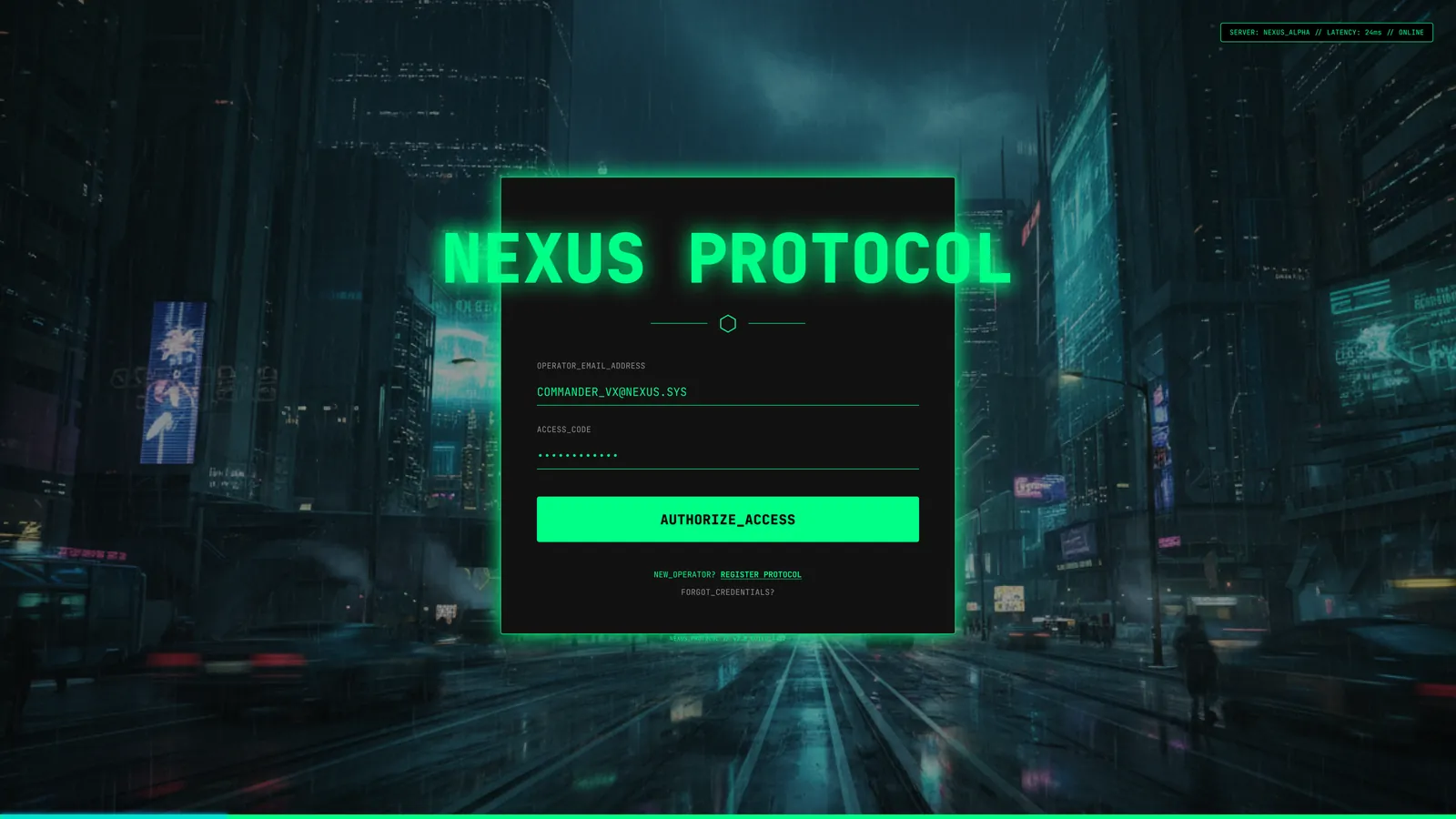
Boot Initializer Splash Login Title Screen Loading
Login screen
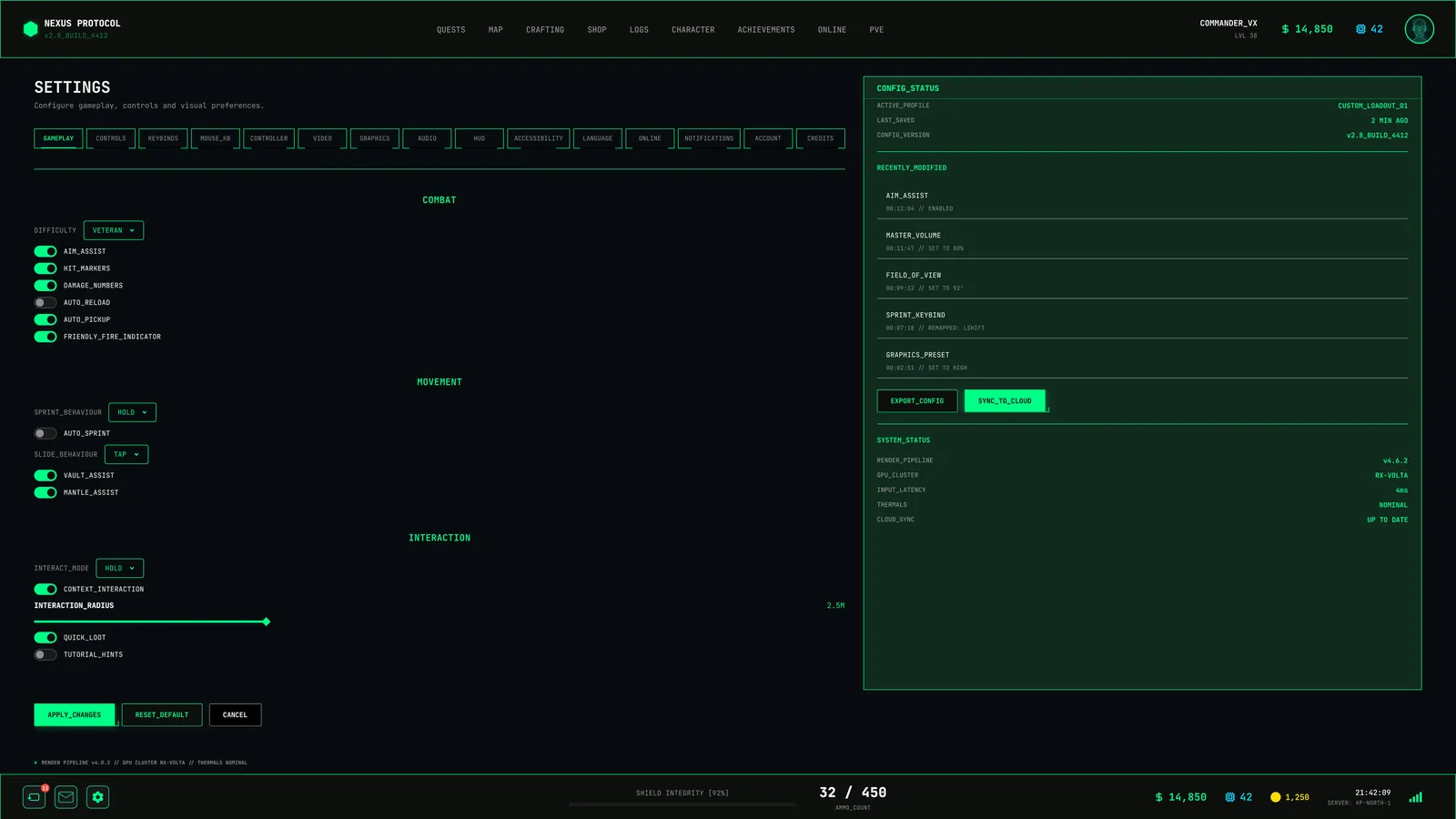
Nexus Protocol — settings
Settings — toggles, dropdowns, sliders and section tabs, all shared components.
Nexus Protocol — Complete Sci-Fi UI System
46 screens · 1,244 components · 323 tokens · clickable prototype · available on UI8
In-World
HUD — Combat, Exploration & Downed
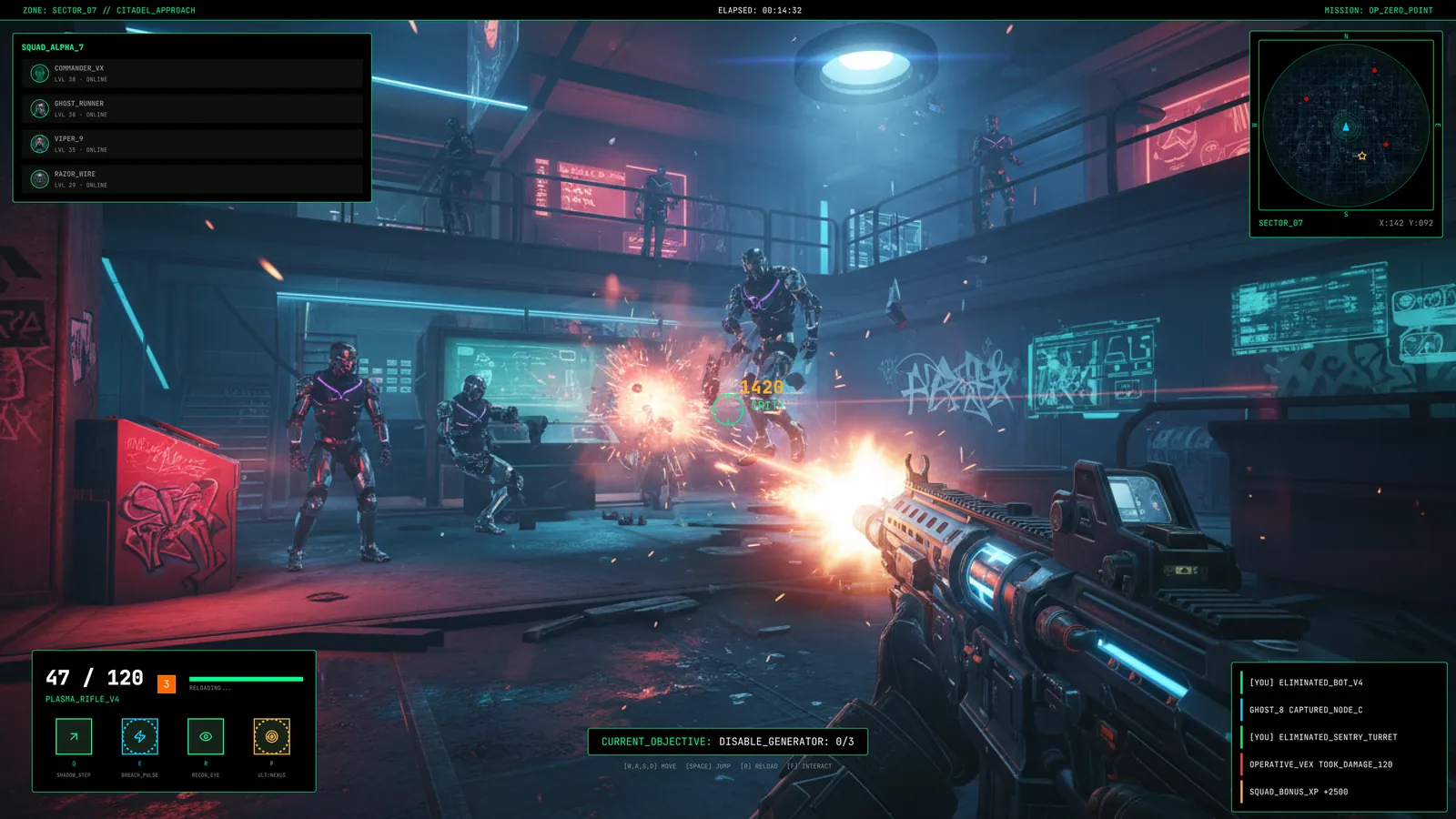
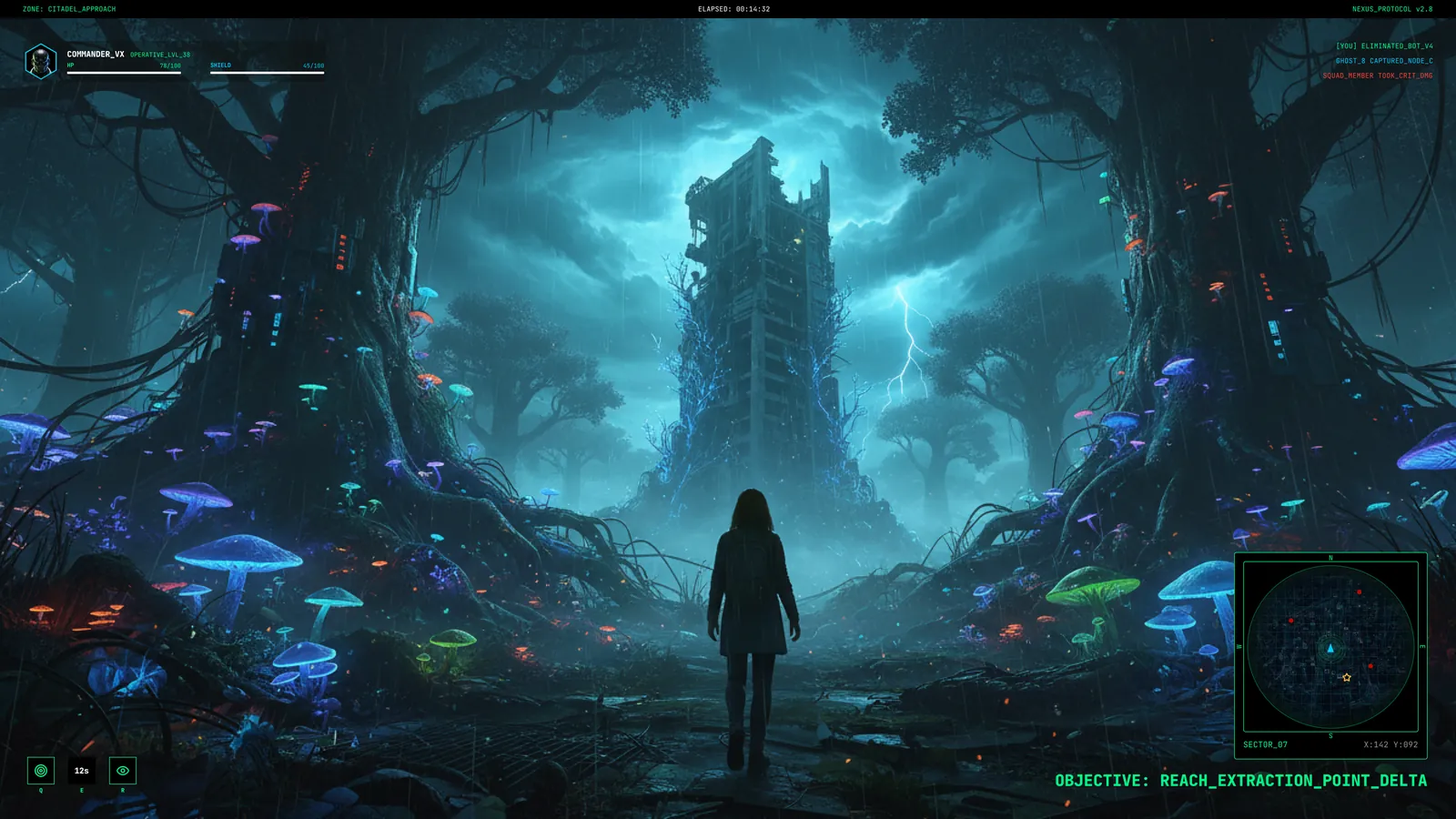
The screen players see most. Three HUD states plus pause menu and loot drop. Health, shield, ammo, radar, objective tracker and squad status — readable at a glance, out of the way of the game world.
Design Principle The world comes first. The HUD only answers questions.
3
HUD States
Pause
+ Loot Drop
Respawn
Prototype Loop
No Chrome
In-World
Nexus Protocol — combat HUD
Combat HUD — ammo, objective, radar and squad panel at the edges, the center stays free.
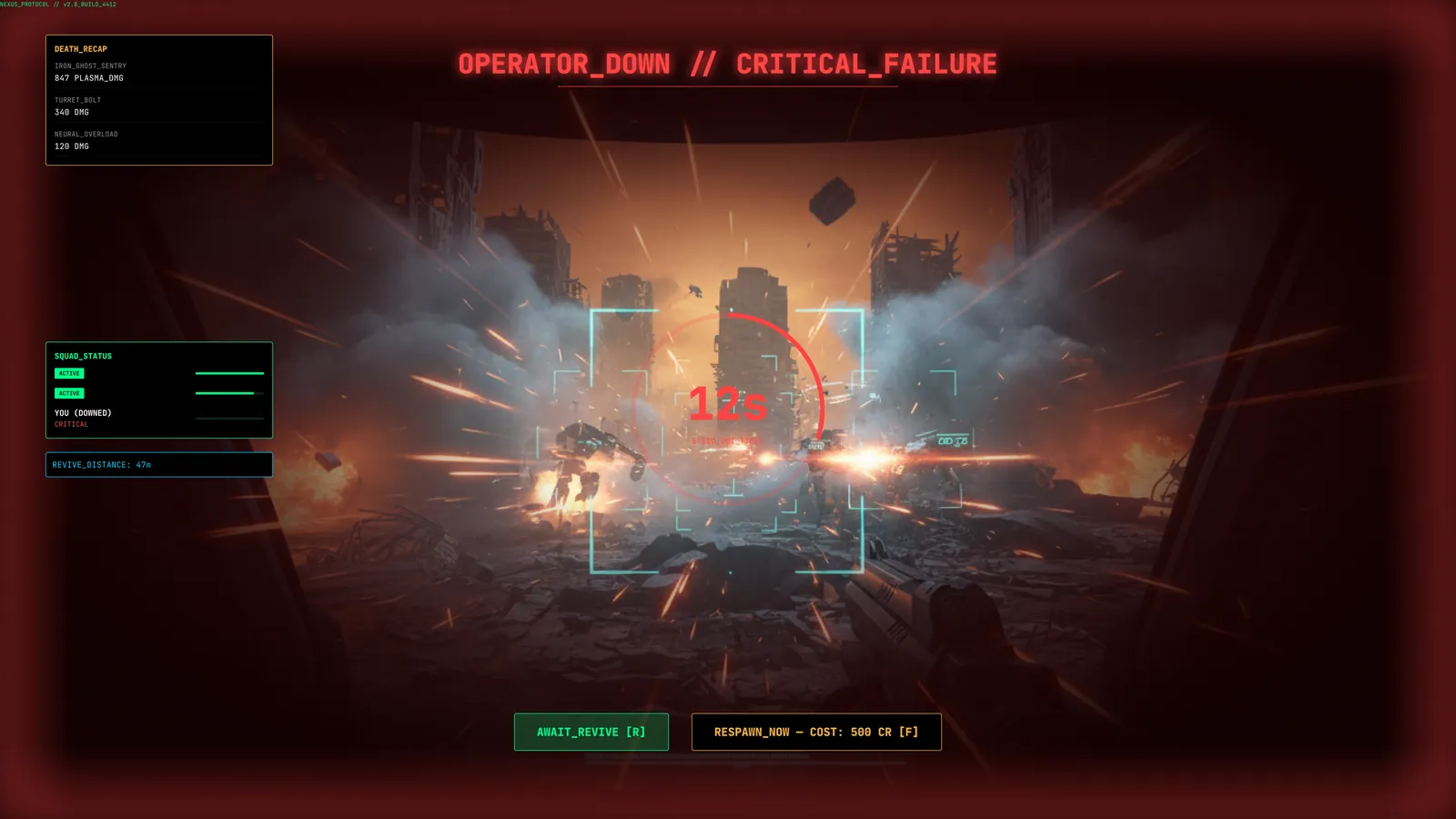
Downed is a state, not a new screen.
When the operator goes down, the HUD switches to a critical state: red alert frame, revive timer, respawn action. In the prototype, the loop runs from mission to downed to respawn and back to the lobby.
Downed HUD state
Exploration HUD state
Overlays

Pause and loot without leaving the world.

Modals sit on a scrim above the game: pause menu, mission complete with loot, item detail. Same panel component, same buttons.
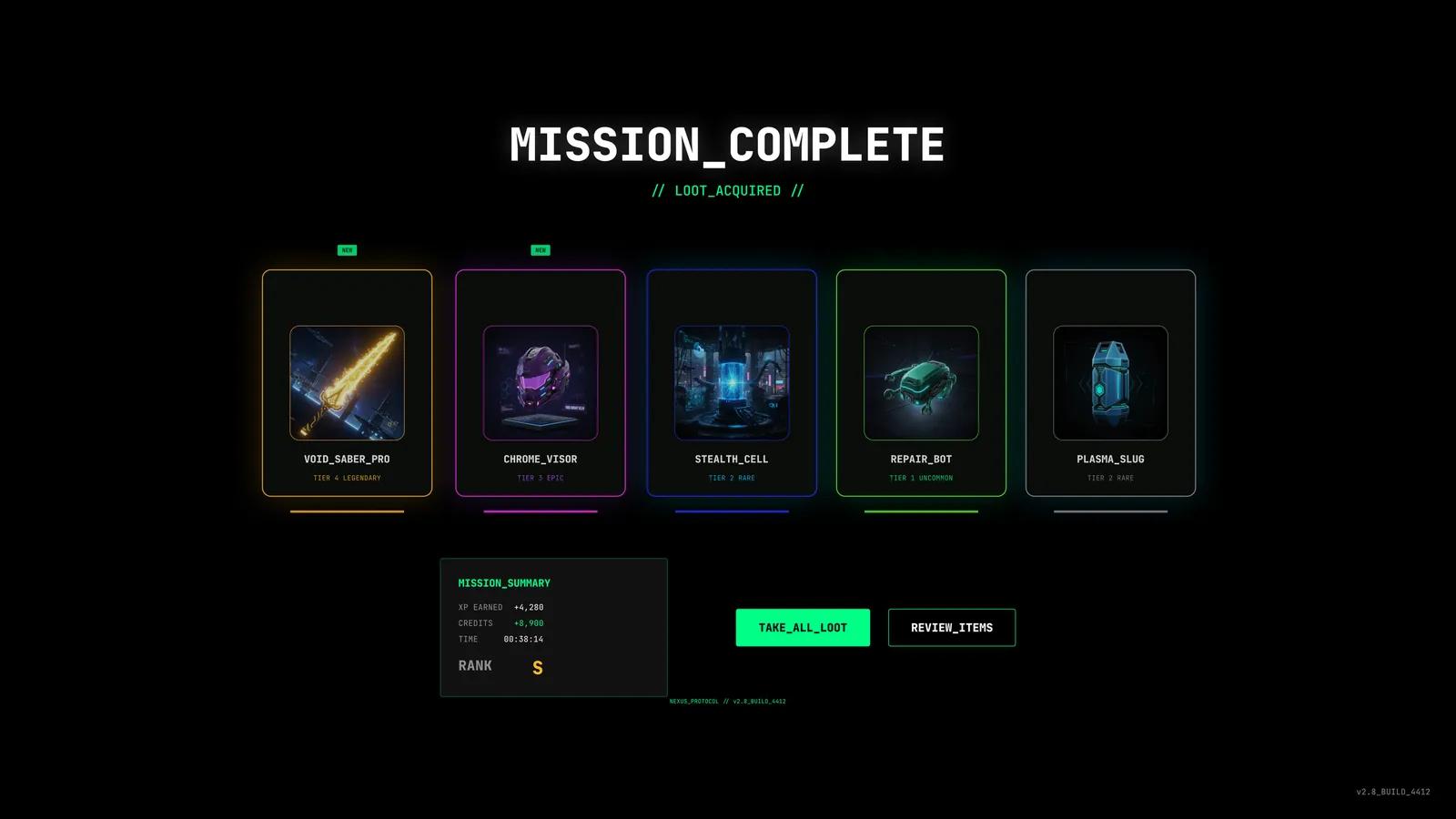
Pause Menu Loot Drop Mission Complete
Loot drop overlay
Nexus Protocol — Complete Sci-Fi UI System
46 screens · 1,244 components · 323 tokens · clickable prototype · available on UI8
Character
Character, Inventory & Skill Tree
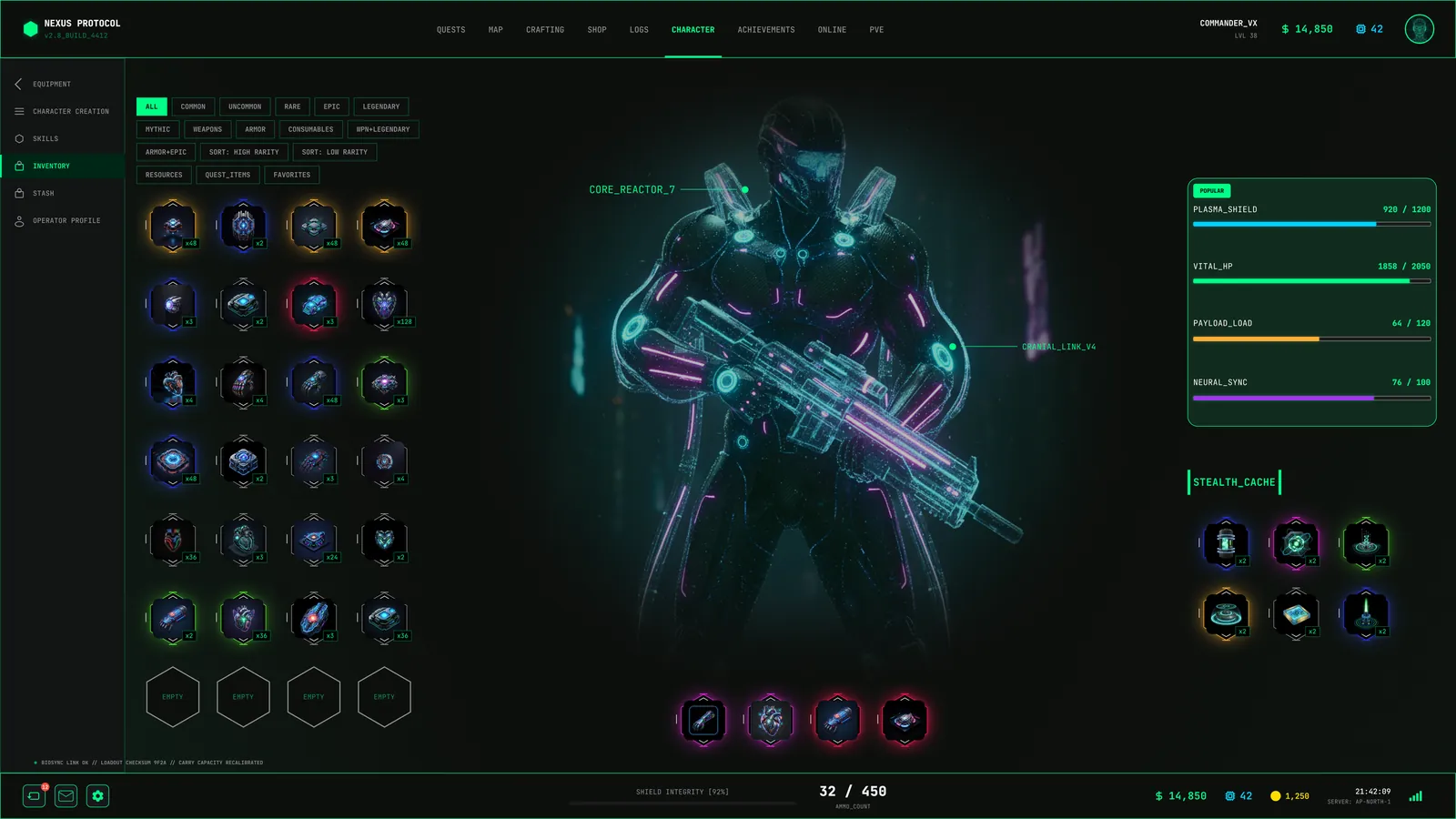
Build the operator before deployment. Character creation, loadout, inventory, stash, operator profile and a hex skill tree — with item detail and compare modals. Every item slot is one component with 7 rarities and 5 interaction states.
Design Principle One item slot. Every rarity, every state.
6
Screens
7
Rarity Tiers
Drag
& Drop Slots
3
Item Modals
Nexus Protocol — inventory
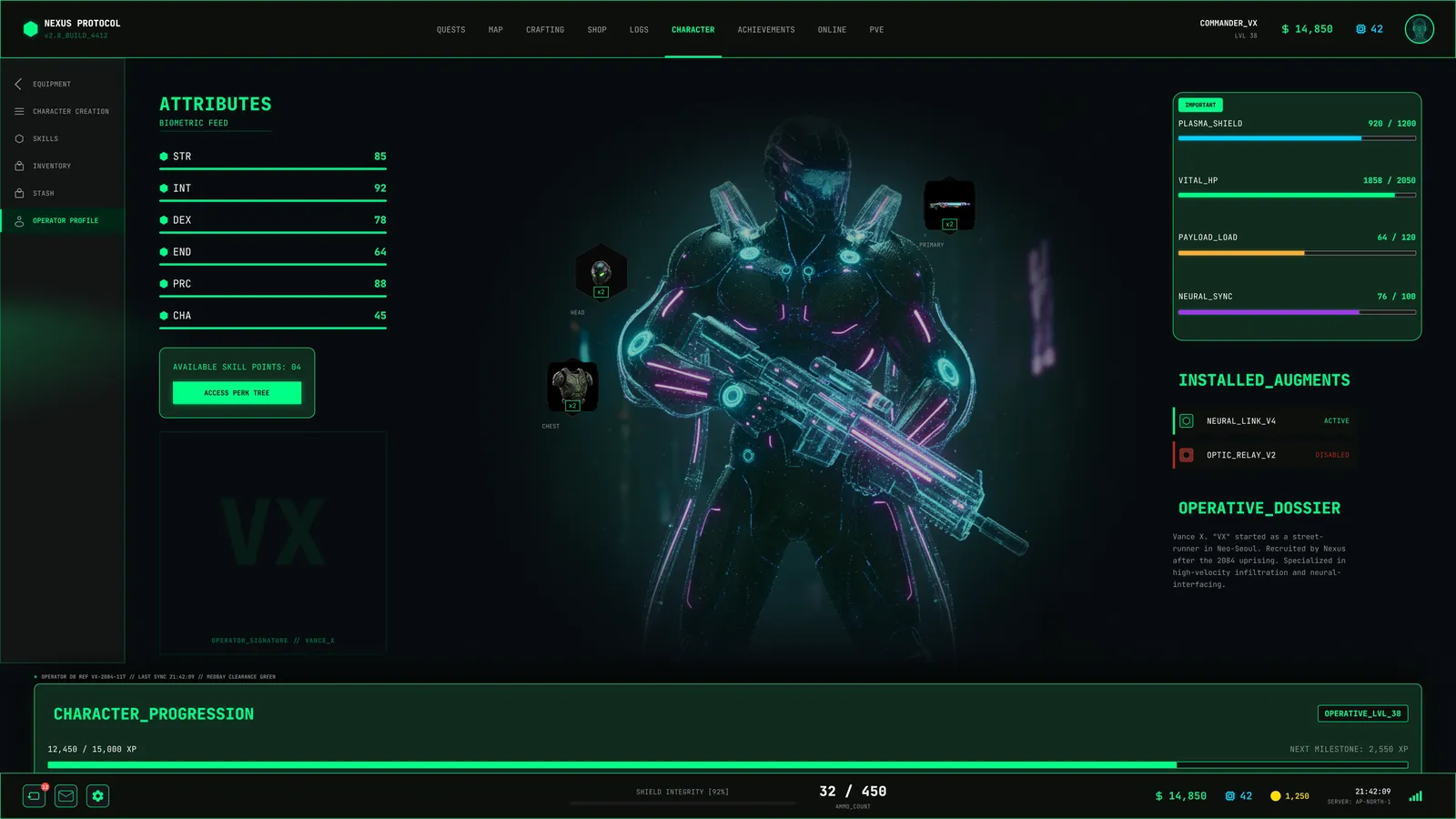
Inventory — hex item grid, operator preview and stat panel. Slots support hover and drag-and-drop in the prototype.
Item Detail

Fully specced. Nothing left to guess.

Stats with upgrade deltas, acquisition source, upgrade path, lore and three actions: Discard, Compare, Equip. One component drives every item.
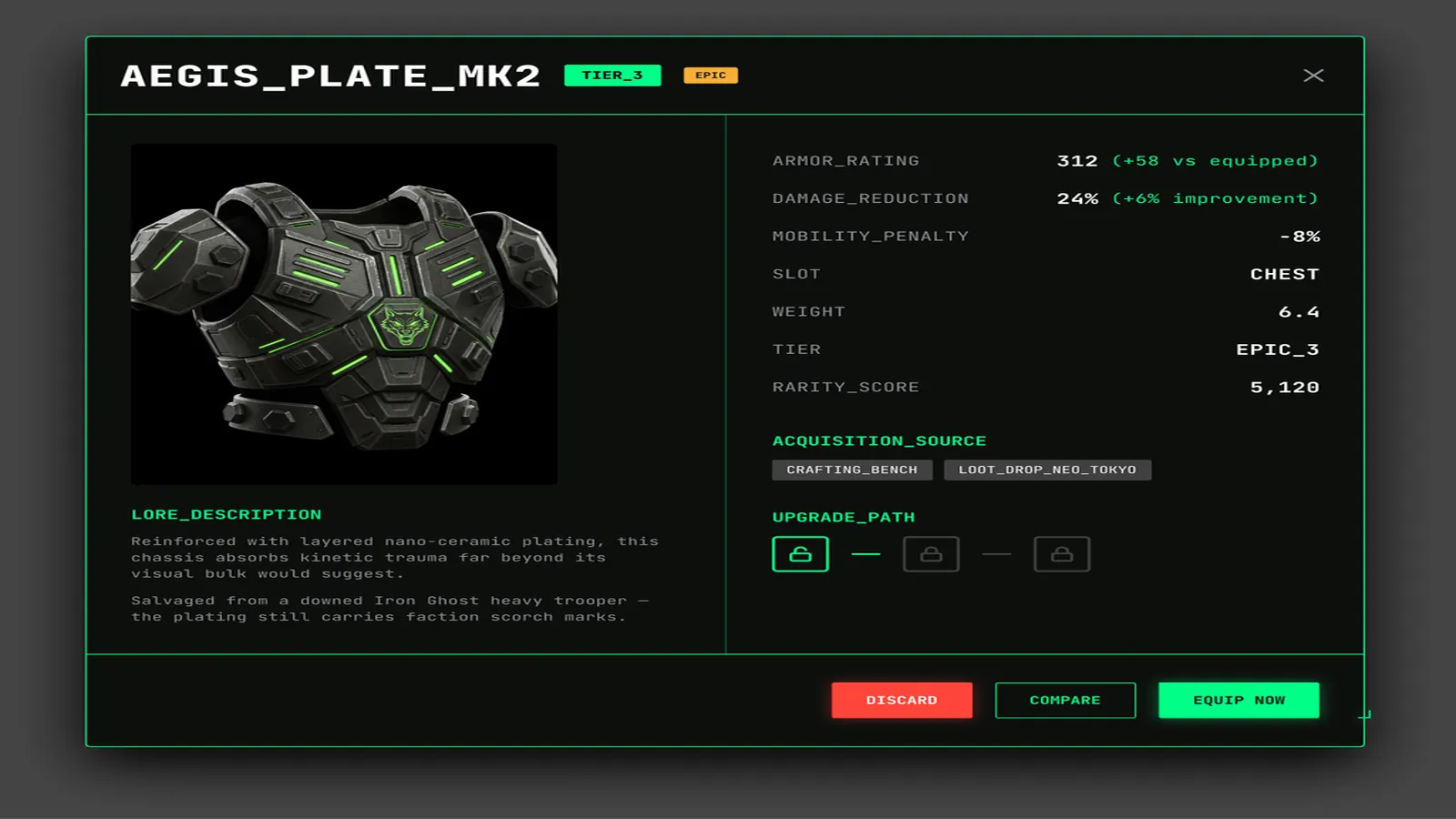
Item Detail Item Compare Rarity Badge 3 Actions
Item detail modal
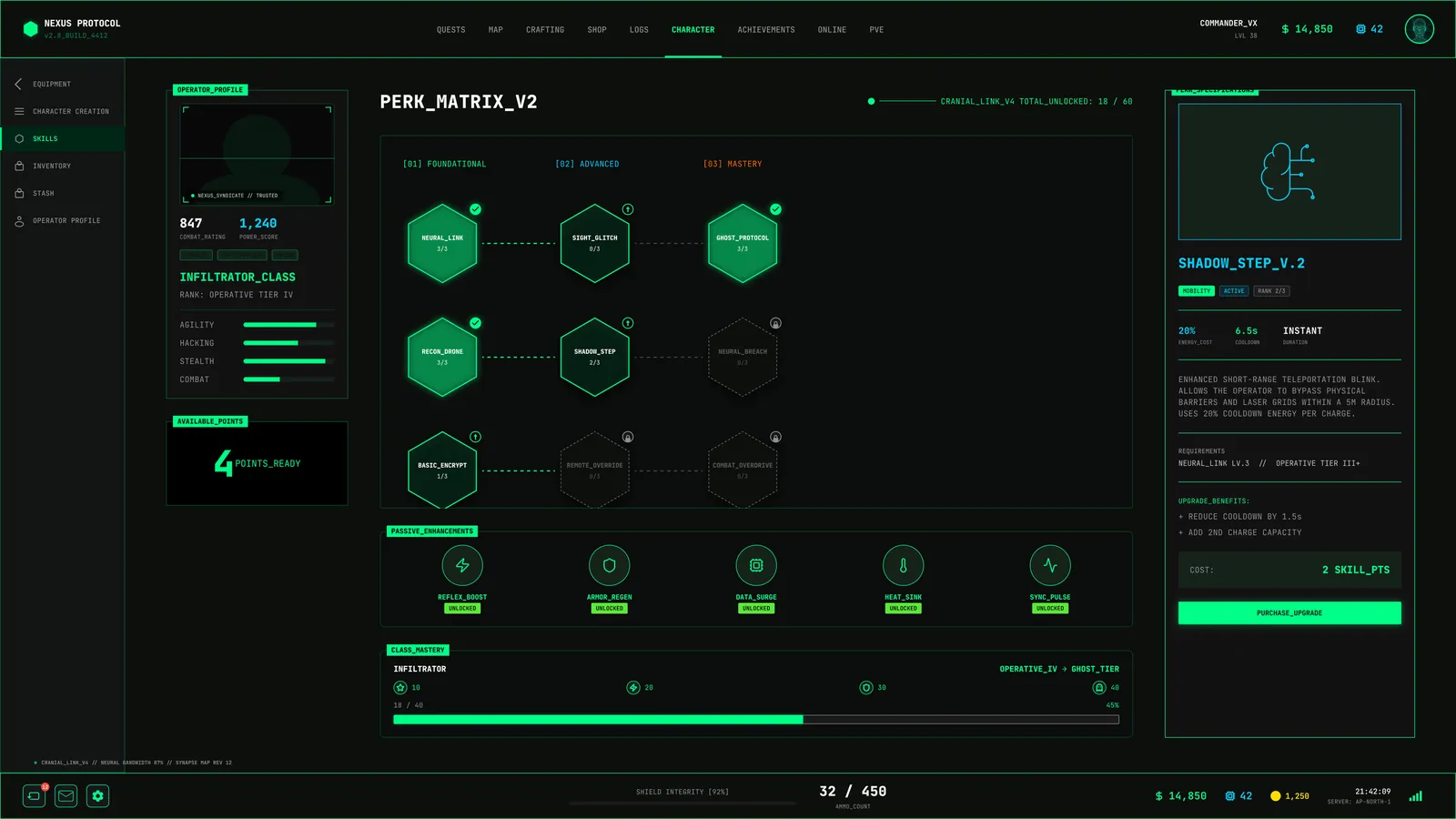
Skill tree with real connectors.
Hex nodes, glowing connectors and a perk detail panel. Progress values like XP or HP are set per instance — not one variant per value.
Skill tree
Operator profile
Character Creation Loadout Inventory Stash Operator Profile Skill Tree Hover + Drag States
Nexus Protocol — Complete Sci-Fi UI System
46 screens · 1,244 components · 323 tokens · clickable prototype · available on UI8
World
World Map — 7 Regions
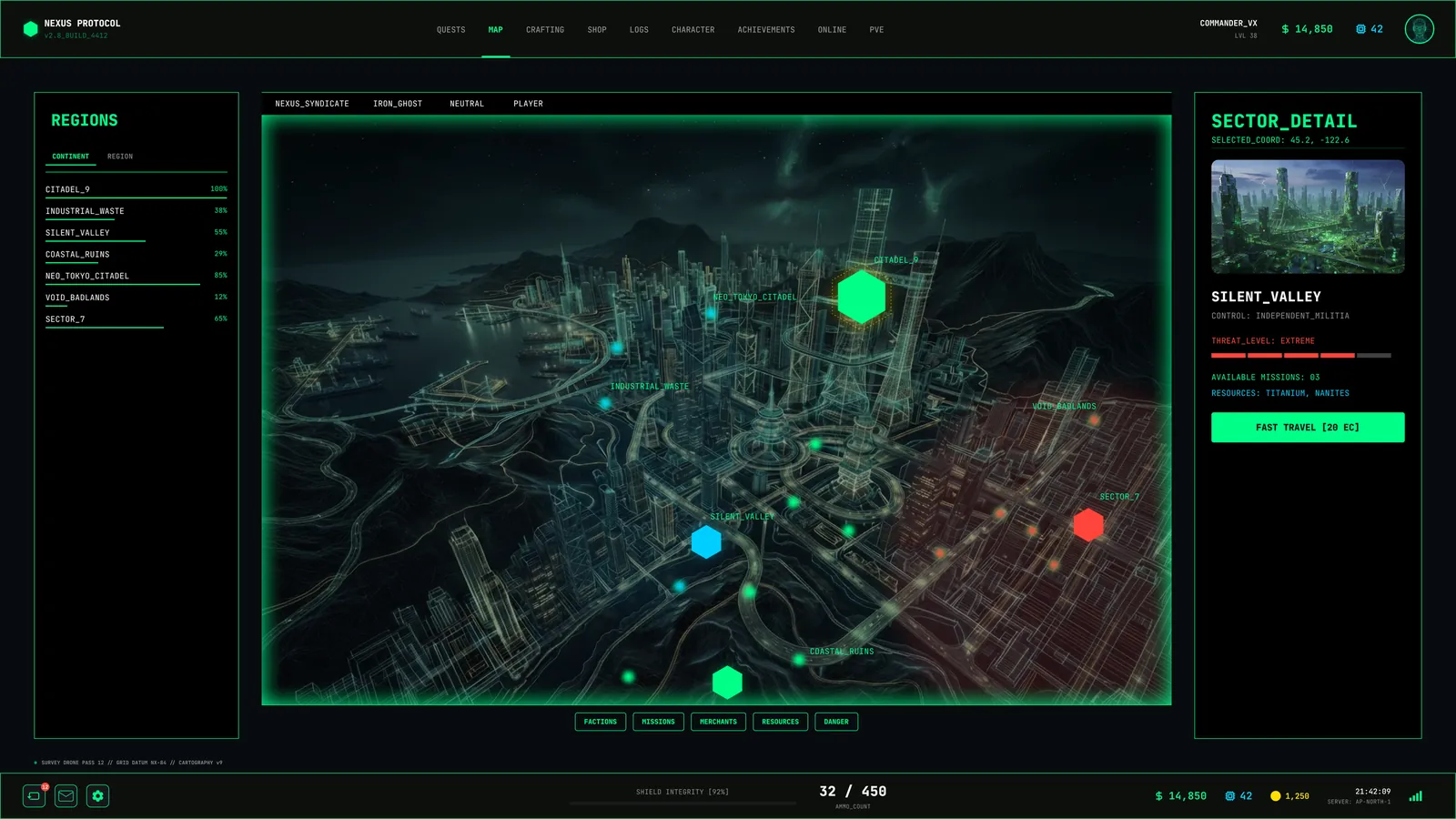
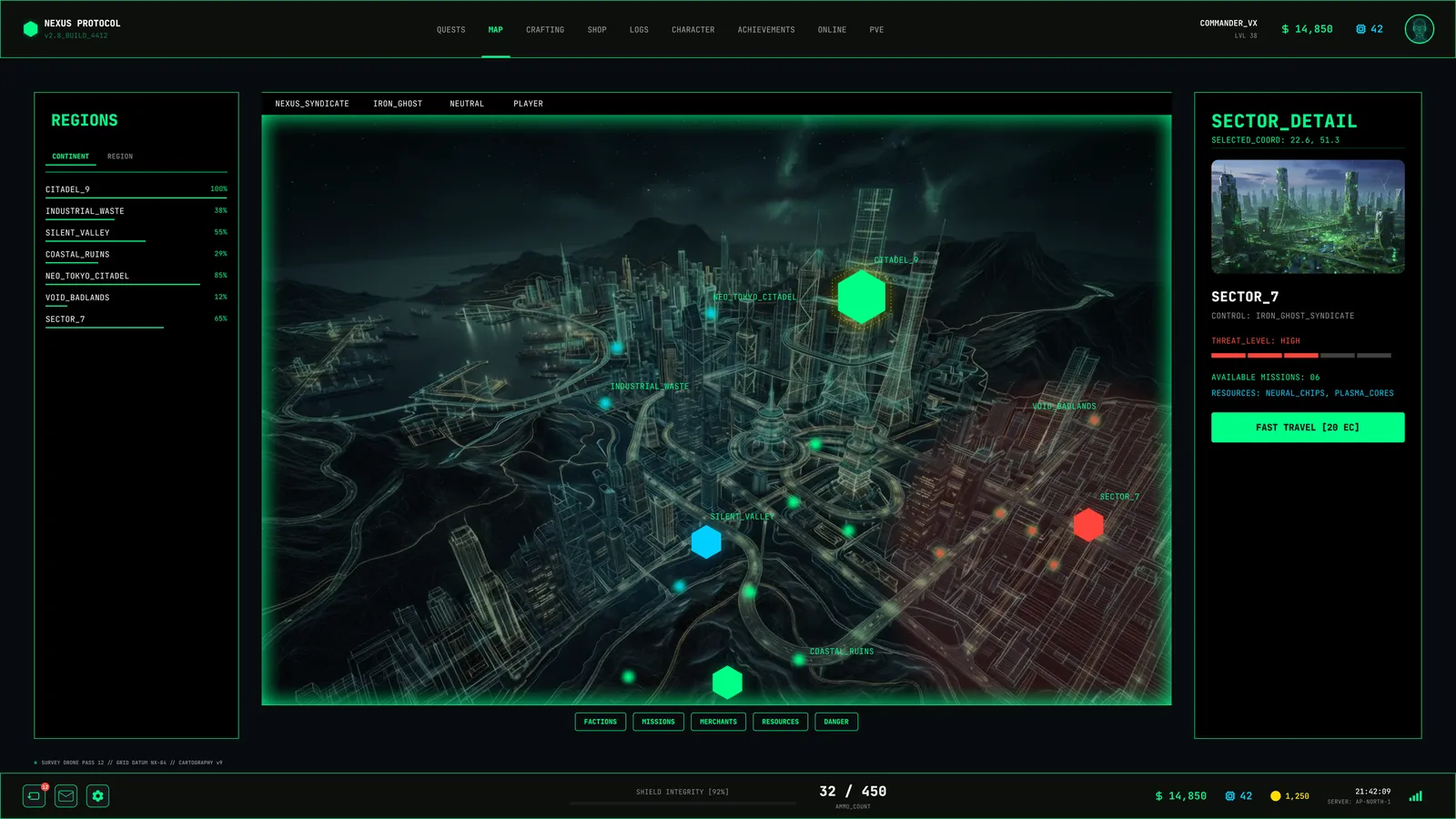
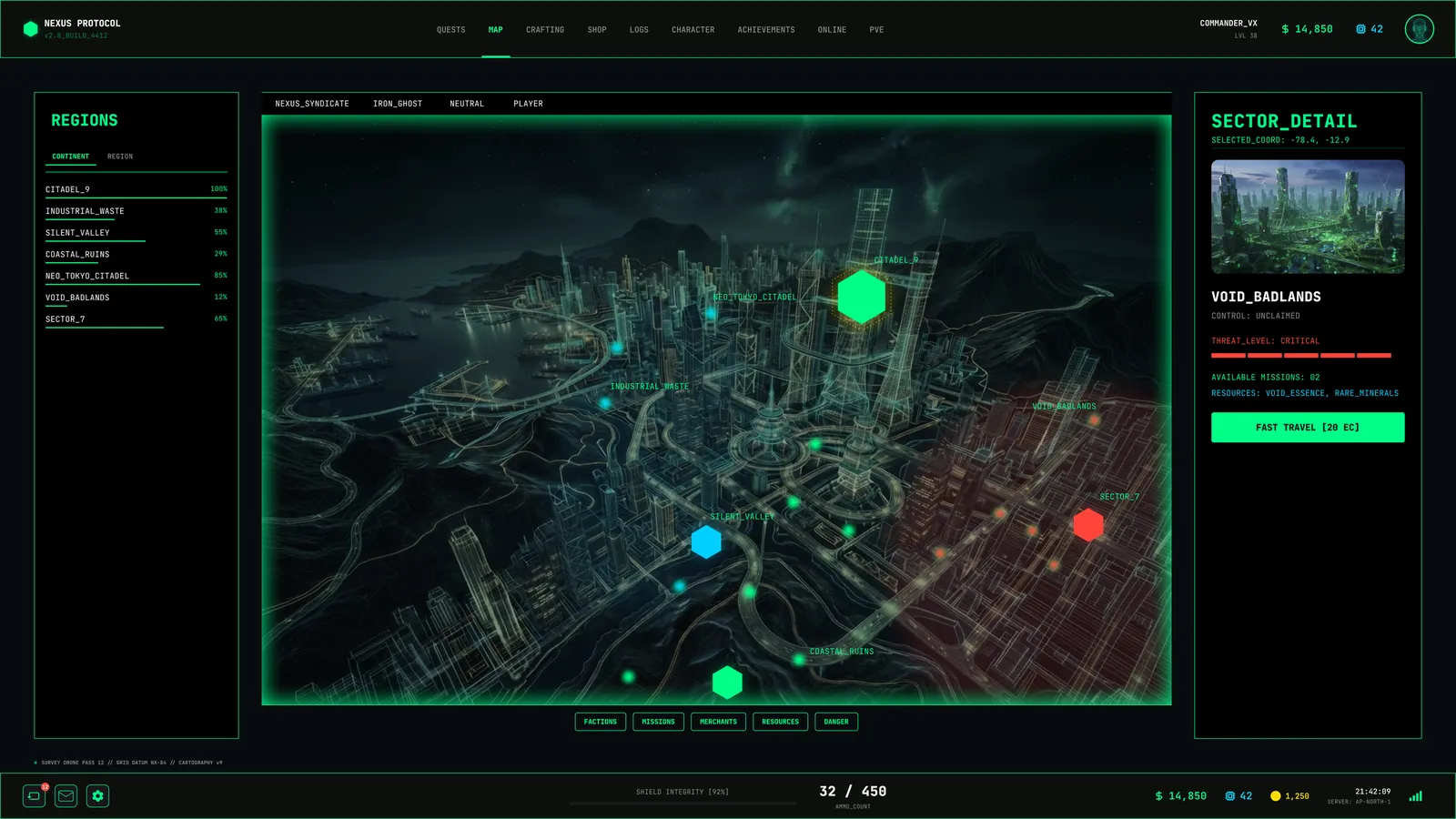
Region list, tactical map and sector detail in one view. The map comes with an overview plus six region-selection states — select a region and the detail panel and markers update.
Design Principle Select on the left. Context on the right.
7
Map Screens
6
Region States
Detail
Sector Panel
Fast
Travel Action
Nexus Protocol — world map
World map — regions (left), tactical map with sector markers (center), sector detail with fast travel (right).
World map — Sector 7 selected
World map — Void Badlands selected
Region List Sector Detail Map Markers Citadel 9 · Coastal Ruins · Industrial Waste Neo Tokyo Citadel · Sector 7 · Void Badlands
Nexus Protocol — Complete Sci-Fi UI System
46 screens · 1,244 components · 323 tokens · clickable prototype · available on UI8
Missions & PvE
Quests, Mode Select, Lobby & Intel
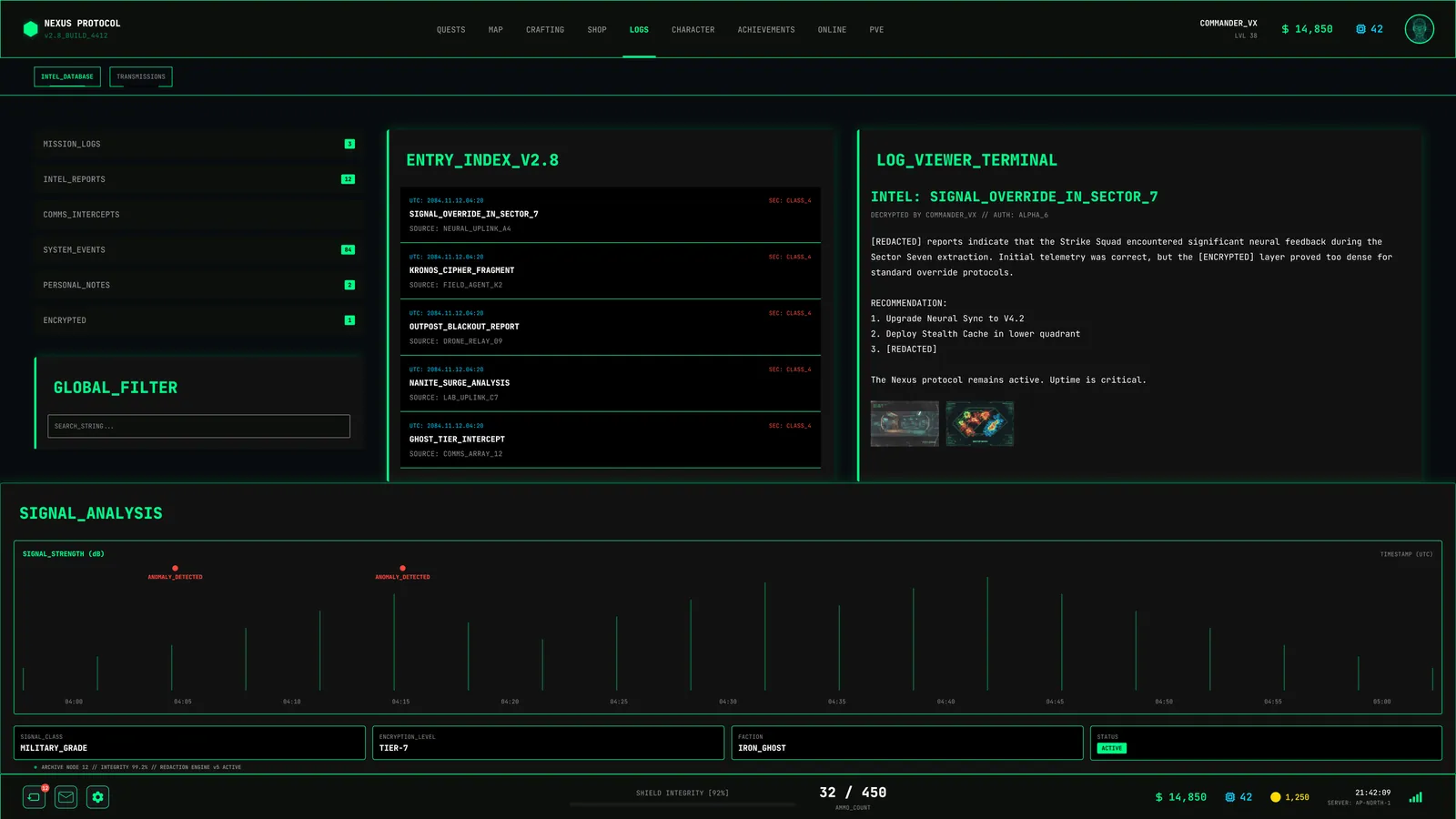
From briefing to deployment. Quest log with objectives and sector preview, play mode select, PvE mission setup, server browser and mission lobby — plus the intel database and transmission center for the story layer.
Design Principle Every step answers one question: what do I do next?
7
Screens
4
Play Modes
Lobby
Squad Ready
Intel
+ Comms
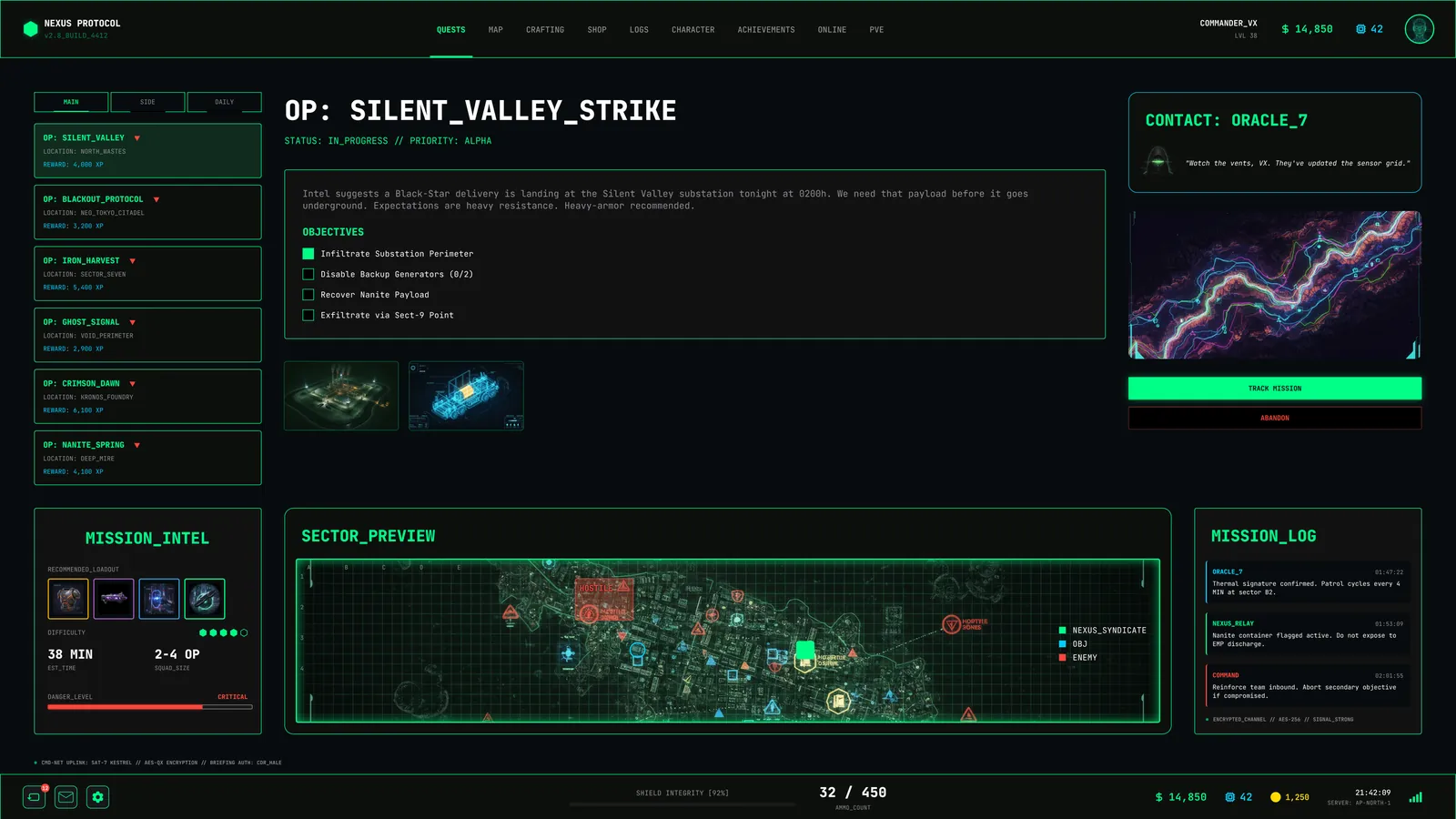
Nexus Protocol — quests
Quest screen — mission list, objectives, contact, mission intel, sector preview and mission log.
Mission Lobby

Squad, map and loadout before deployment.

Squad slots with ready state, mission preview and one clear action: Initialize Mission. The prototype continues from here into loading and the HUD.
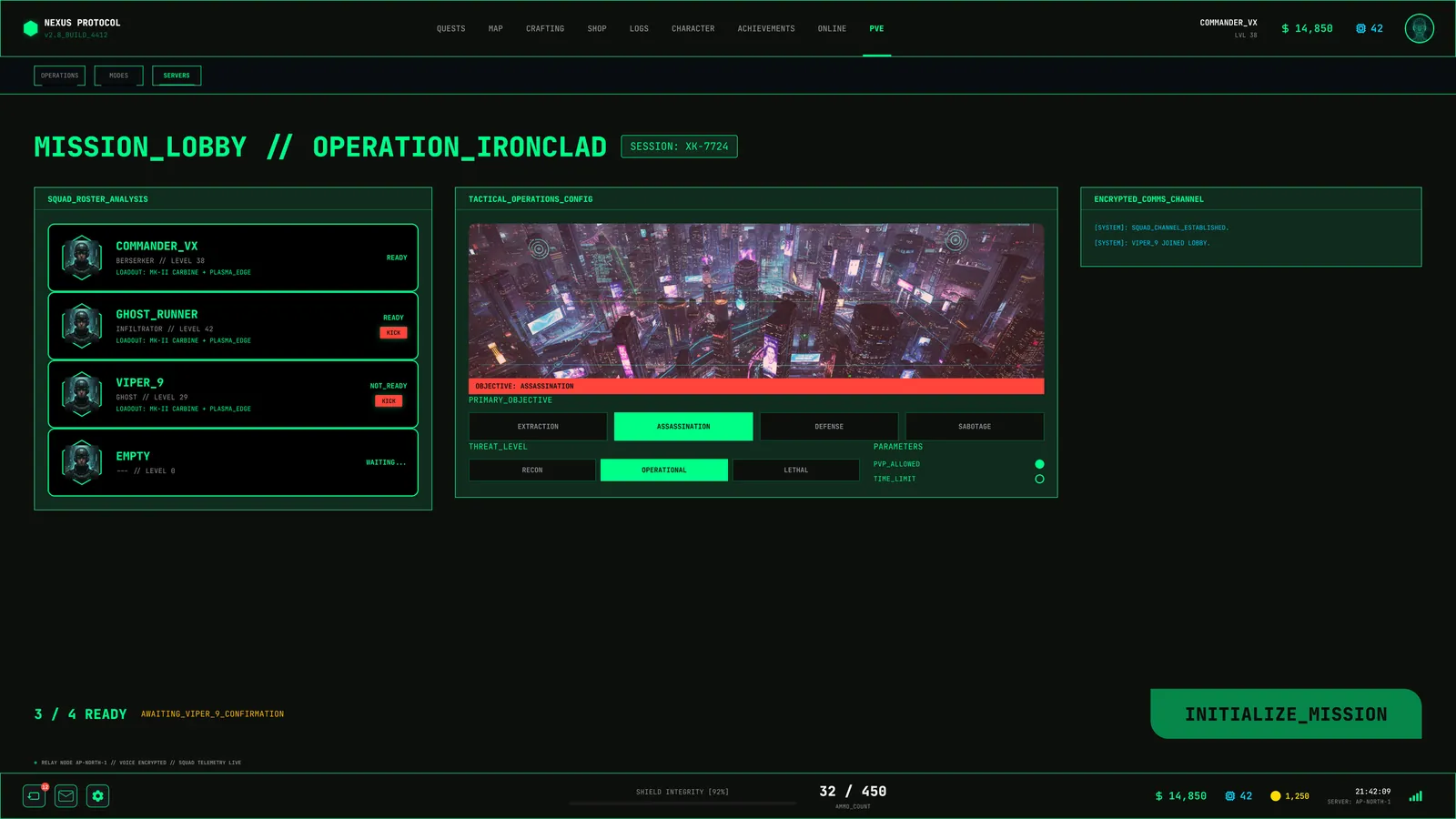
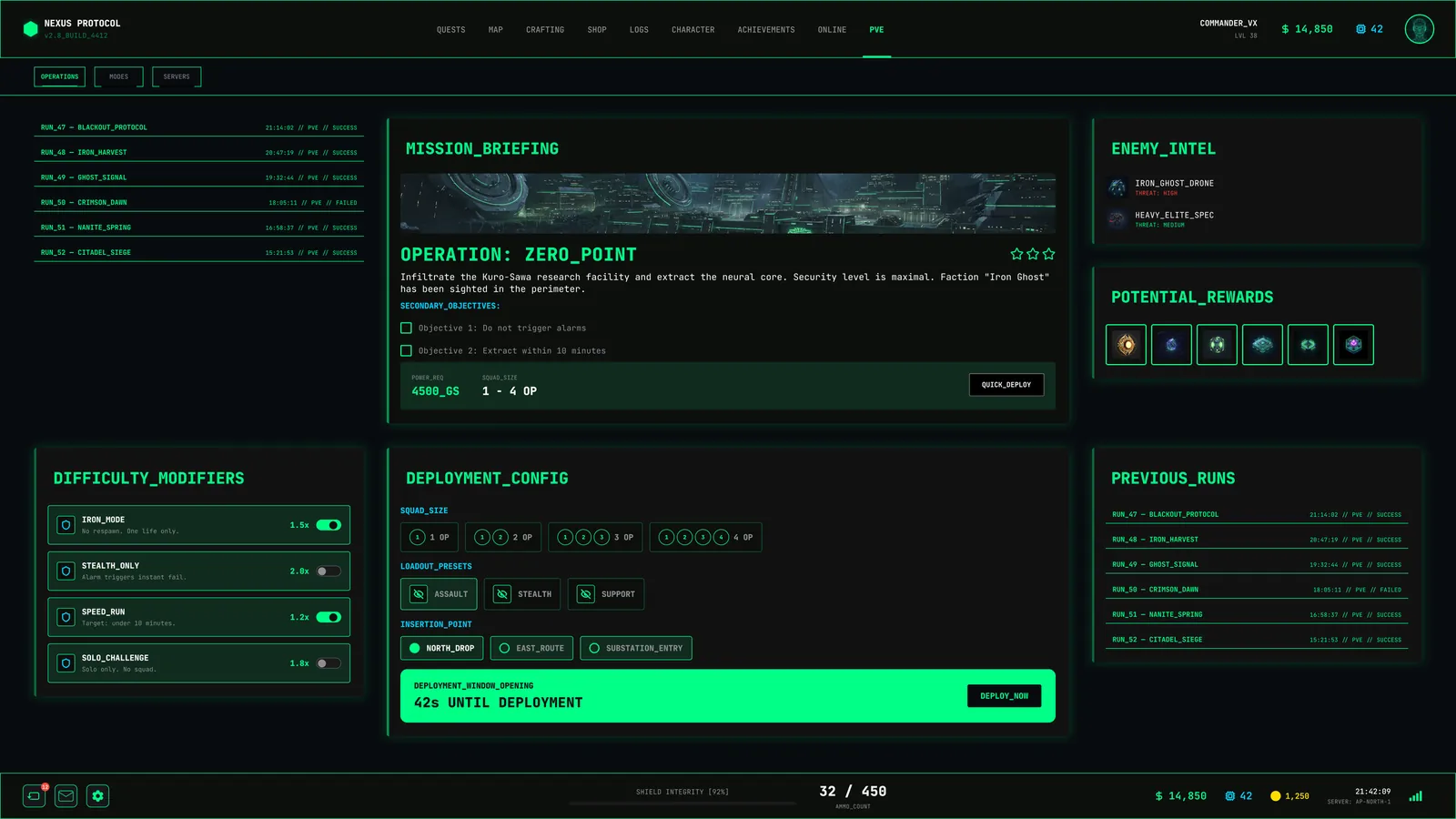
Mission Lobby Play Mode Select PvE Setup Server Browser
Mission lobby
PvE mission setup
Intel database
Nexus Protocol — Complete Sci-Fi UI System
46 screens · 1,244 components · 323 tokens · clickable prototype · available on UI8
Online
Social Hub, Clan & Leaderboards
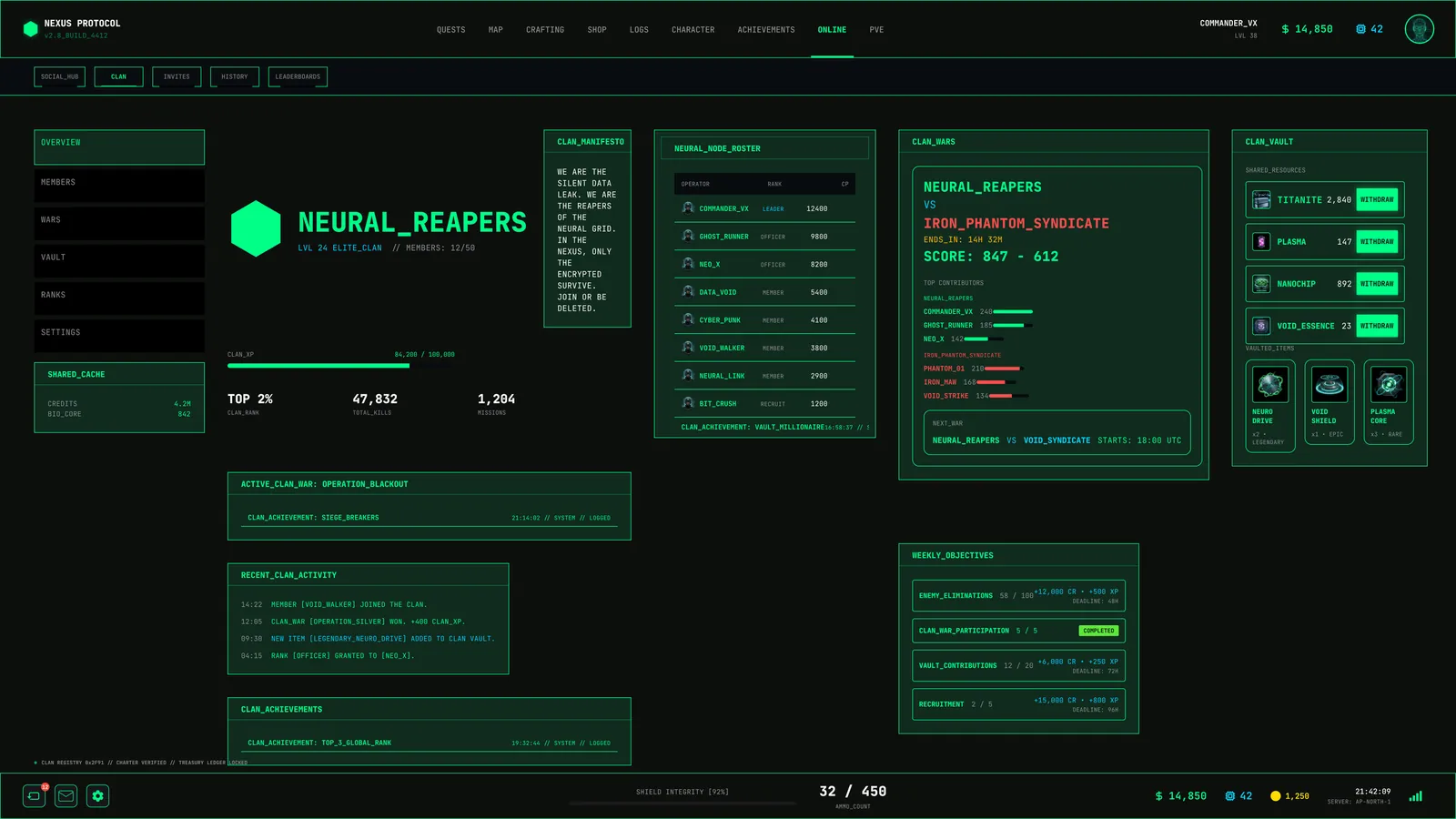
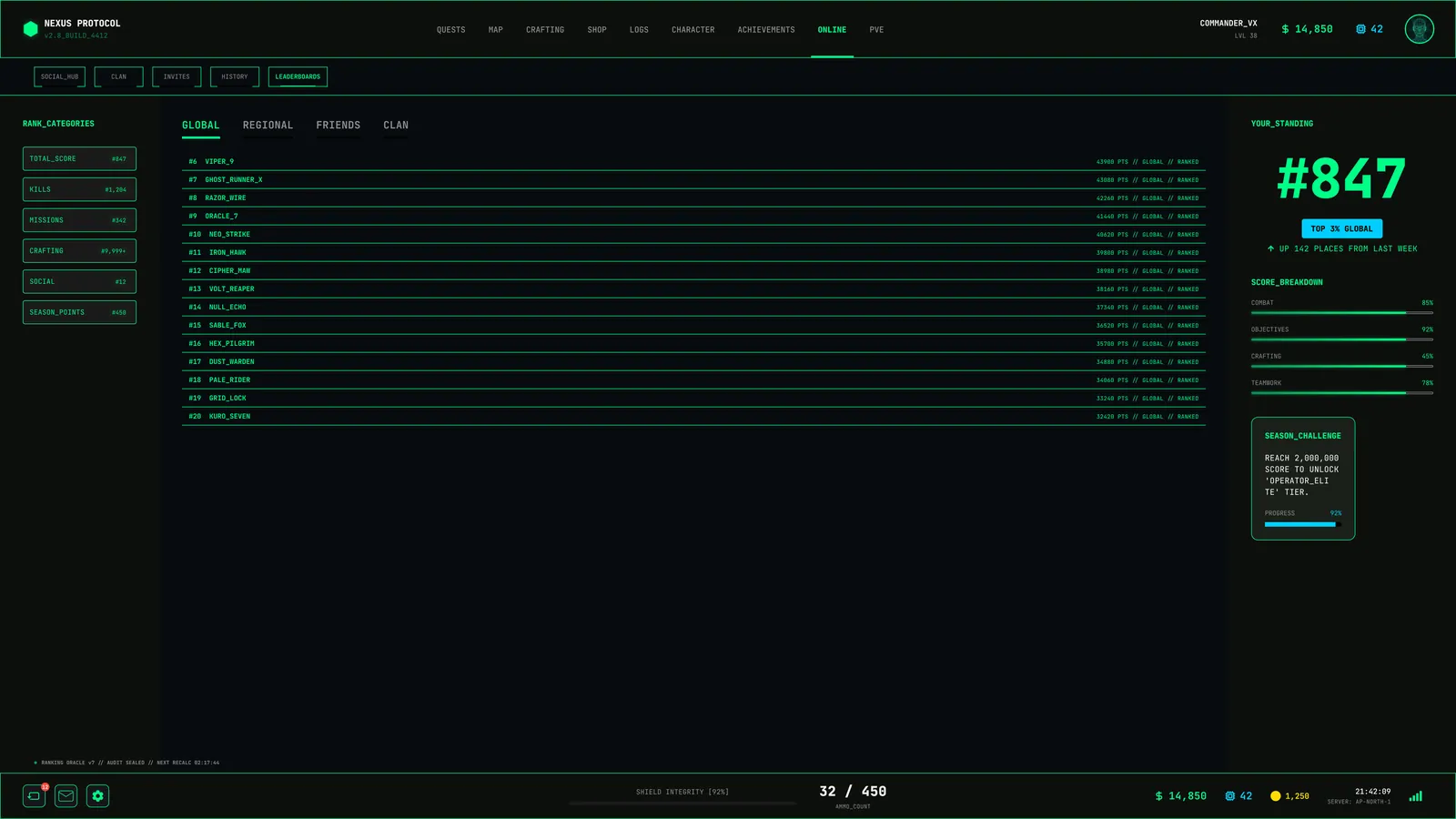
Everything a live-service shooter needs around the match. Social hub, clan, squad invitations, friend profile, match history and leaderboards — tables built from one list-row component, so they read as real data.
Design Principle Dense data, still readable.
6
Screens
1
List Row Component
Feed
+ Invites
Ranks
Leaderboards
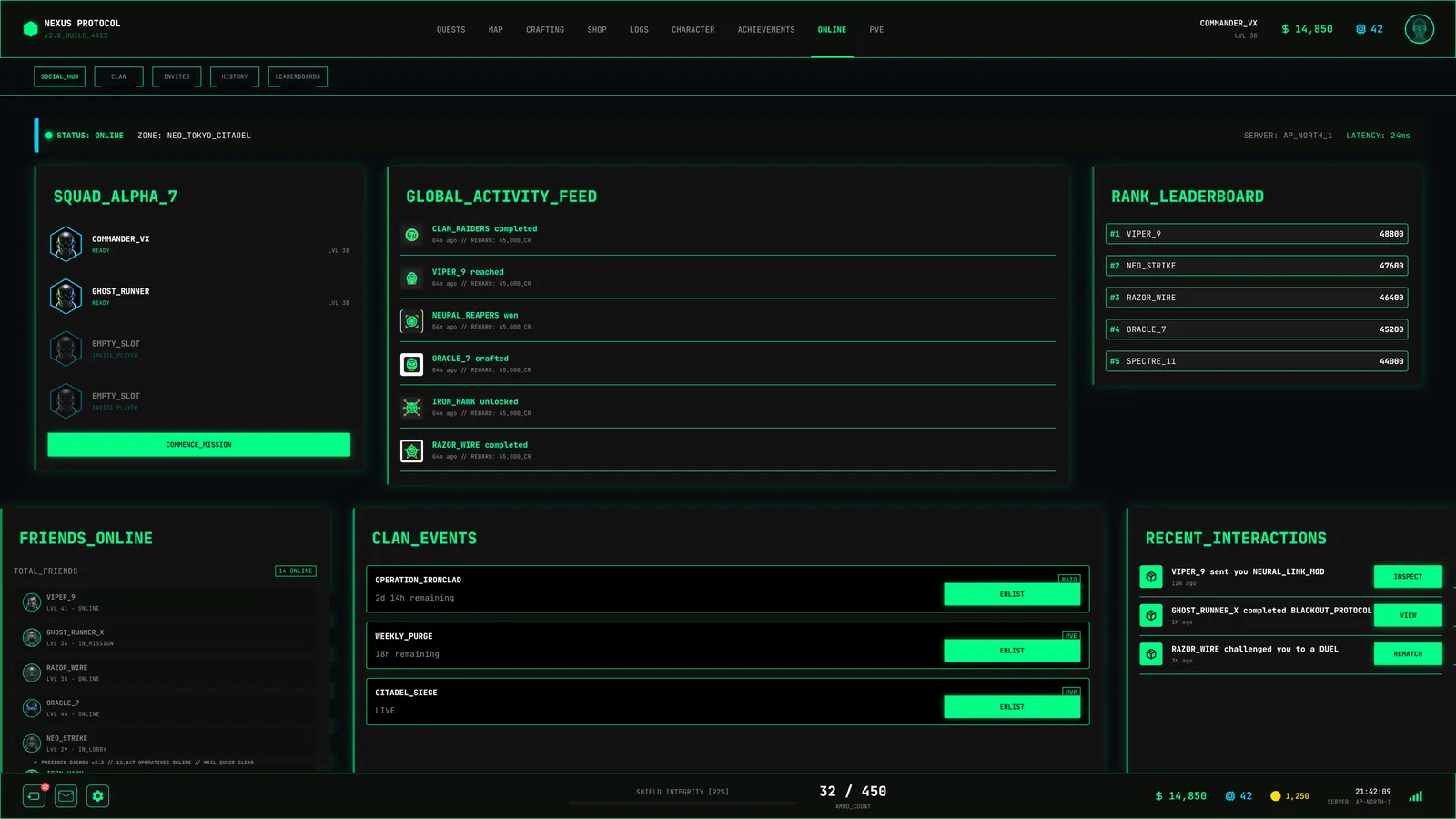
Nexus Protocol — social hub
Social hub — squad, activity feed, rank leaderboard, friends online, clan events, recent interactions.
Clan screen
Leaderboards
Social Hub Clan Squad Invitations Friend Profile Match History Leaderboards
Nexus Protocol — Complete Sci-Fi UI System
46 screens · 1,244 components · 323 tokens · clickable prototype · available on UI8
Economy & Progression
Shop, Marketplace, Crafting & Season Pass
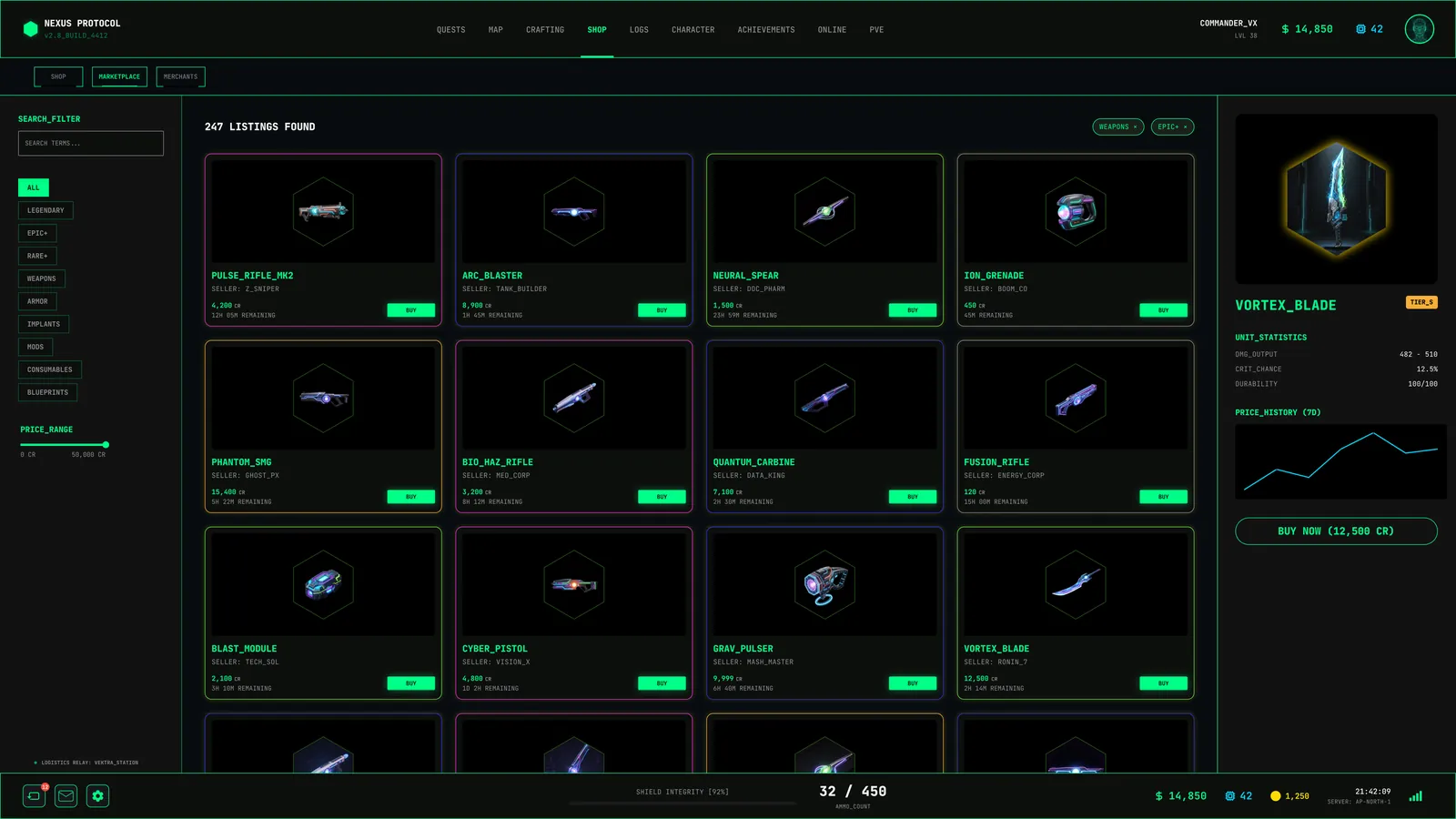
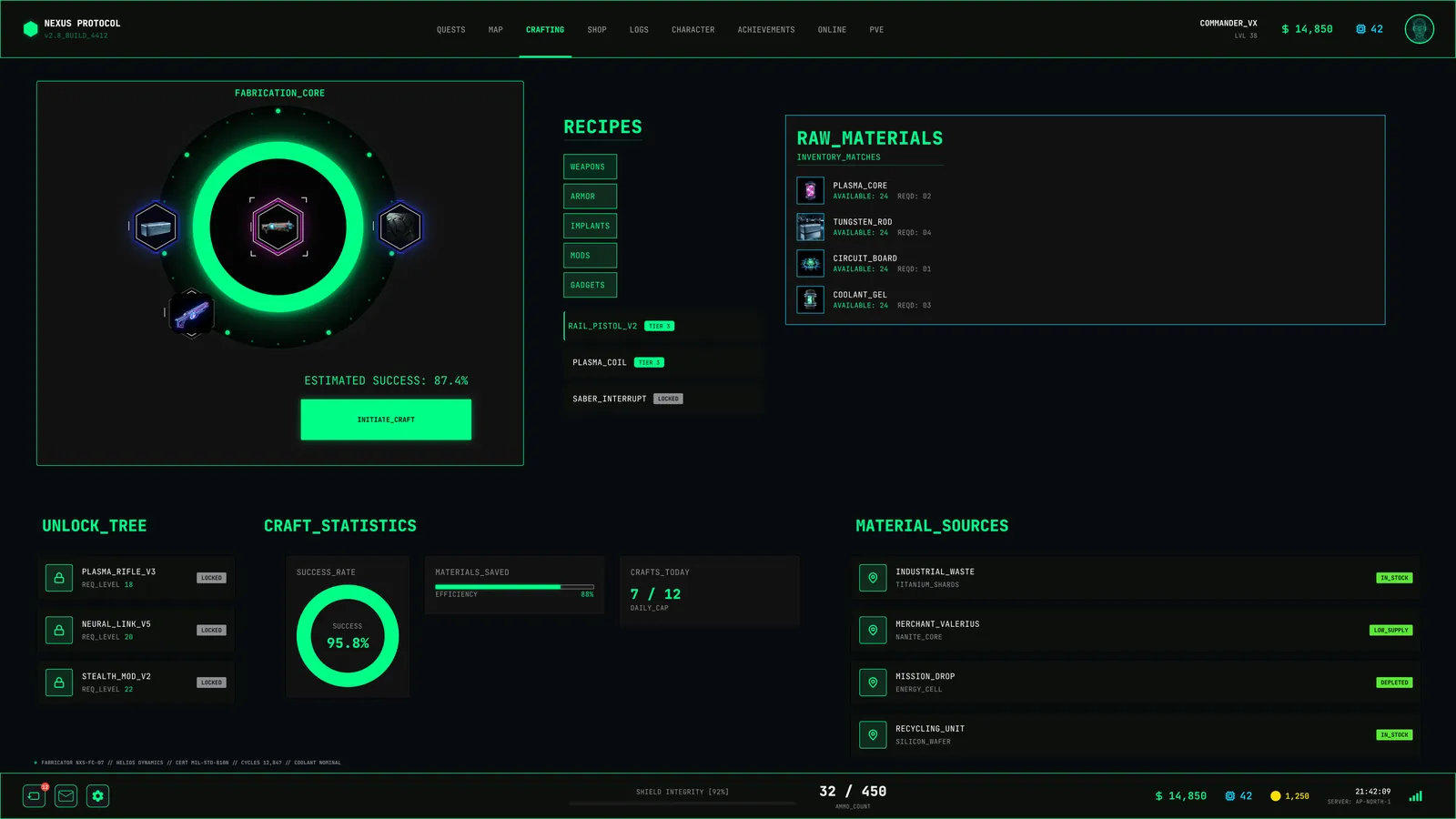
Build it or buy it. In-game shop, player marketplace, merchant network and crafting — plus season pass and achievements for long-term progression. Buy actions lead to the item detail in the prototype.
Design Principle Price, rarity and action — always in the same place.
6
Screens
Listing
Card Component
Craft
+ Recipes
Season
Pass Tiers
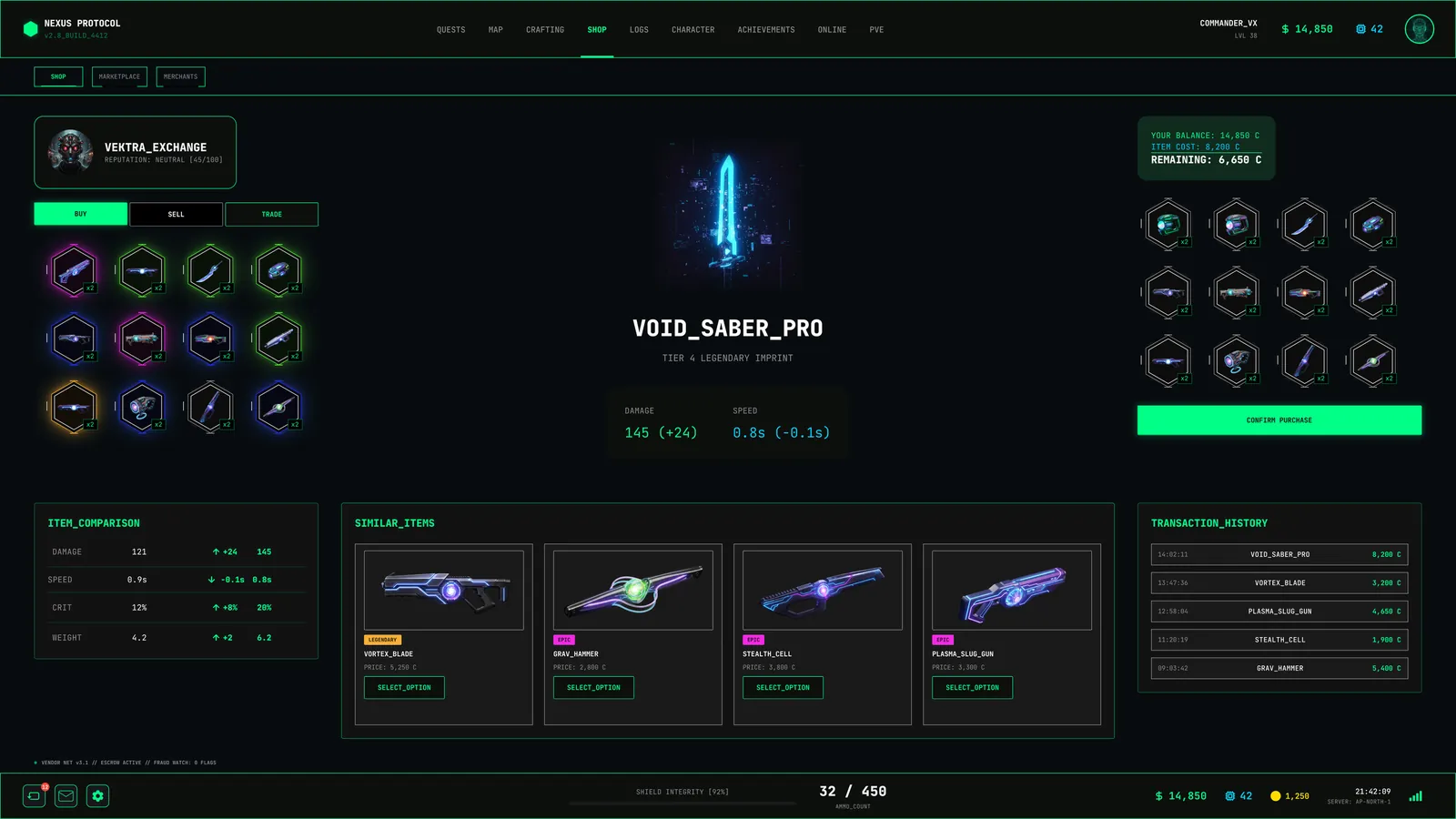
Nexus Protocol — shop
Shop — featured item, category tabs, stat comparison and similar items.
Marketplace
Crafting
Season Pass

Progression that keeps players coming back.

Free and premium reward tracks, tier progress and a featured reward — plus an achievements screen with completion stats and badges.
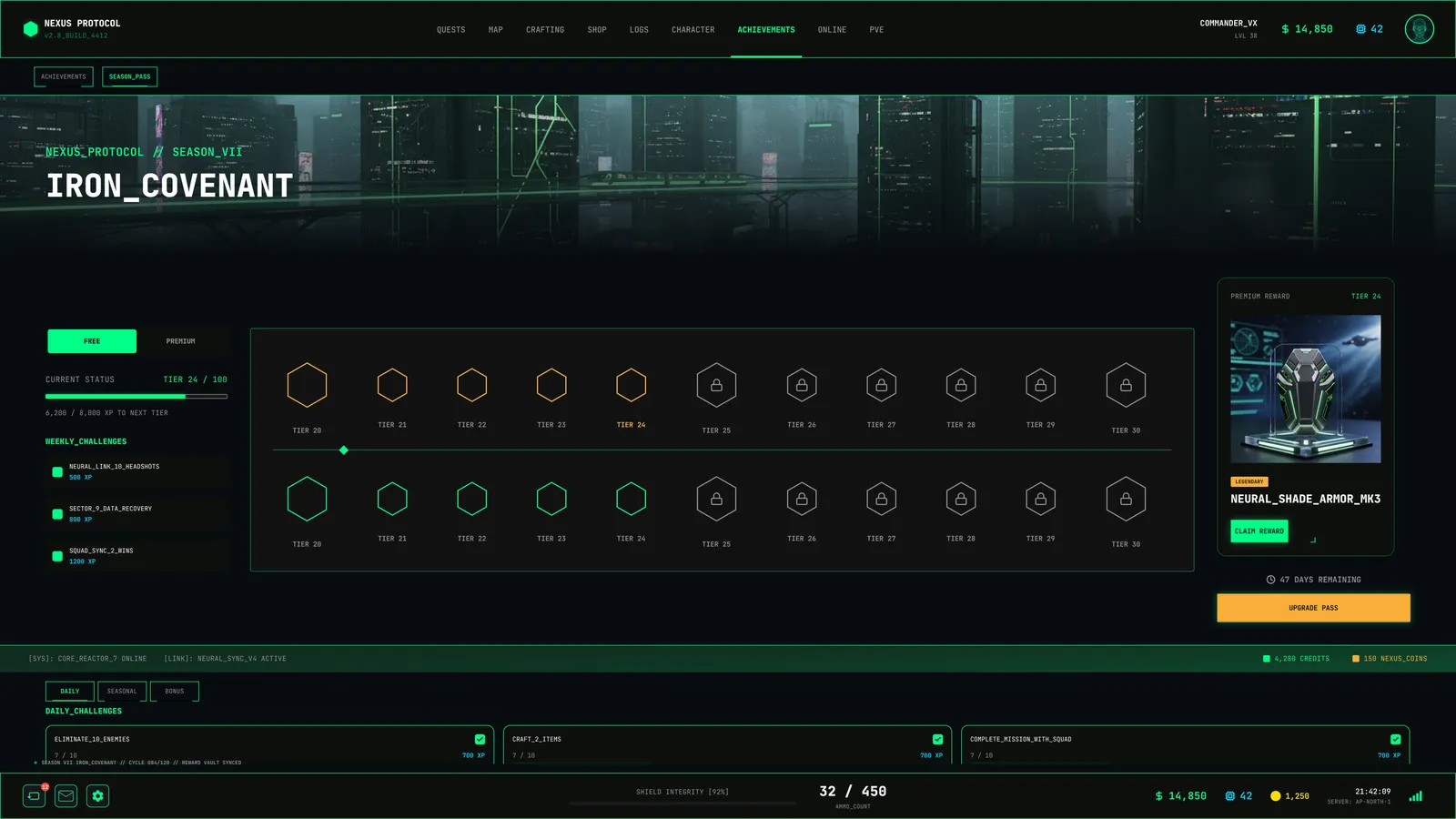
Season Pass Achievements Merchant Network
Season pass
Nexus Protocol — Complete Sci-Fi UI System
46 screens · 1,244 components · 323 tokens · clickable prototype · available on UI8
Component System

Built once.
Reused everywhere.

Every screen in Nexus Protocol is assembled from the same component library. Update one component — every instance across 46 screens follows.

46 Screens
↓
1,244 Components
↓
323 Variables
↓
One Design System
Change one token. Restyle every screen.
Built with Auto Layout, Component Properties, and Variables.
172
Component Sets
1,151
Variants
323
Variables
11,549
Instances
0
Broken Links
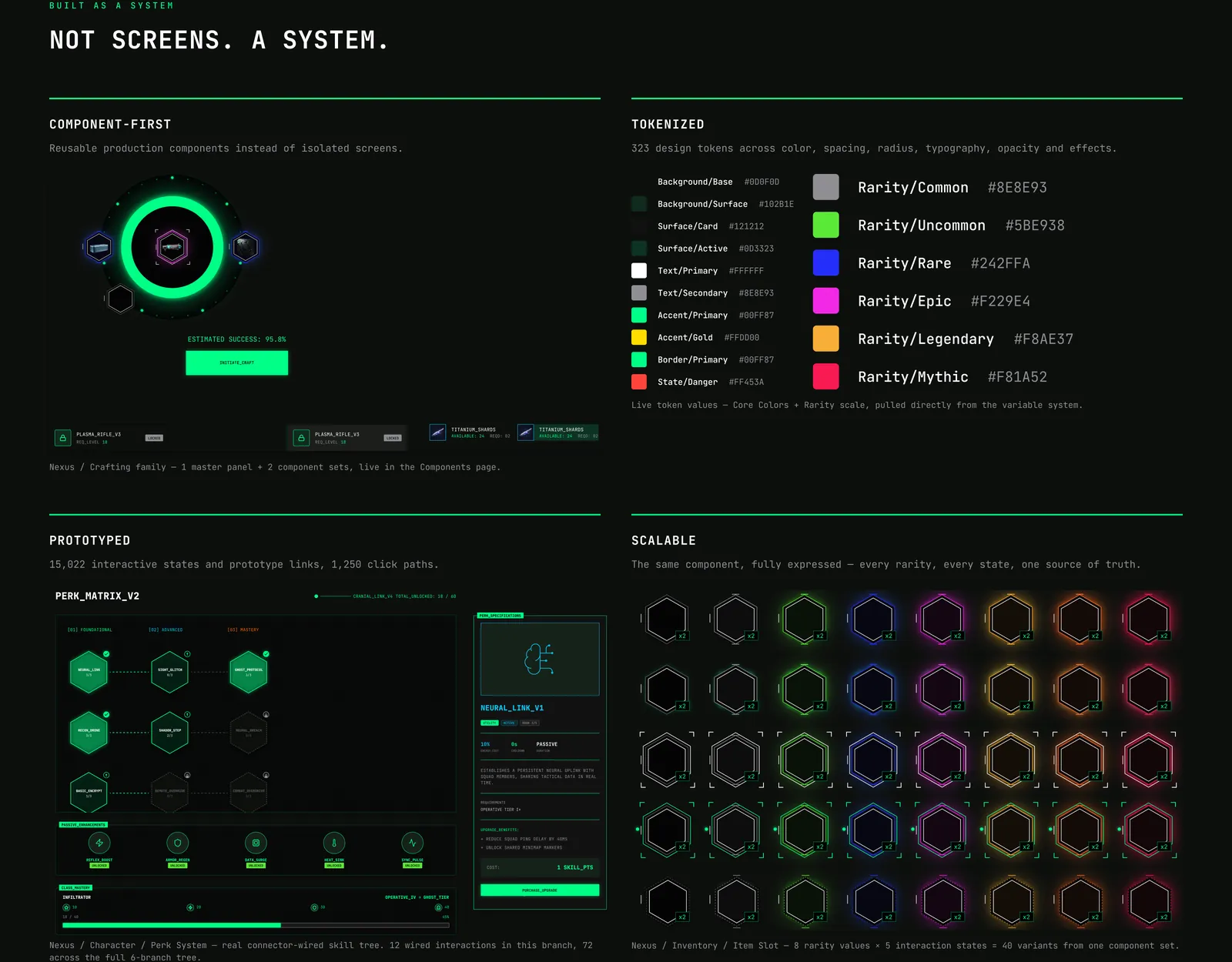
Nexus Protocol — component-first, tokenized, prototyped, scalable
Typography
JetBrains Mono
The only font — titles, data, body
18 text styles
Regular · Medium · Bold · ExtraBold
Free via Google Fonts (SIL Open Font License)
Variable Collections
Primitive · Semantic · Game
Raw values, purpose-named roles, rarity and state
Spacing · Radius · Opacity
Layout and shape scales
Effects · Typography · Stroke
9 collections, 323 variables
Naming Convention
Nexus / Category / Name
e.g. Nexus / Global / Button
State=Hover · Rarity=Epic
Readable variant properties, never "Property 1"
Background → Navigation → Layout → Overlay
Same layer hierarchy in every screen
◆
Atoms to Regions
Buttons, badges and meters; stat rows and list rows; offer cards; whole information regions. Each pattern is owned by exactly one component.
◆
State vs. Data
Discrete states are variants. Continuous values like HP, XP or progress are set per instance — no variant per value.
◆
Variant Architecture
Default, Hover, Selected, Active, Dragging, Disabled. One item slot covers 7 rarities × 5 interaction states.
◆
Self-Contained File
No plugins, no external libraries. Cover, Foundations, Components, Screens — everything is inside.
1,244 Components 172 Component Sets All States Included Auto Layout Consistent Naming Figma Variables
Nexus Protocol — Complete Sci-Fi UI System
1,244 components · 46 screens · 323 tokens · Auto Layout · Figma Variables · available on UI8
Design System
Color Variables — Tokenized
Near-black panels, one neon green accent, gold for currency, red for danger. Every color is a variable, every rarity one swap.
#0D0F0D — Background
#00FF87 — Accent
#FFDD00 — Gold
#8A38F5 — Purple
#FF453A — Danger
Common
Uncommon
Rare
Epic
Legendary
Exotic
Mythic
323 Design Tokens — Part of Nexus Protocol
9 variable collections · 7 rarity tiers · swappable colors · get the full system on UI8
Ready to build your next shooter?
Nexus Protocol
Complete Sci-Fi Game UI System
46 Screens · 1,244 Components · 323 Design Tokens · Clickable Prototype
Component-driven.
Tokenized.
Production ready.
Get it on UI8 — $79 →
Also on itch.io →
Images and icons are Figma AI sample artwork. See the license.